New state-of-the-art system for analysis of complex samples
Reinforcing the strong position of UvA/HIMS in Field-Flow Fractionation
21 September 2026
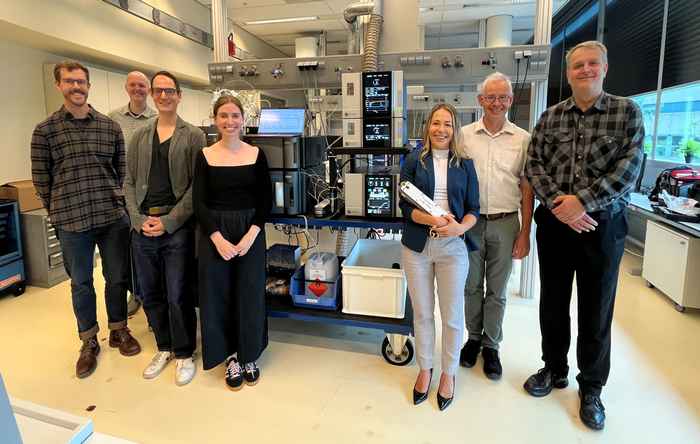
The new equipment employs the principle of Field-Flow Fractionation which minimises unwanted molecular interactions during analysis. “Our institute has a long history in this field”, says Alina Astefanei, assistant professor in analytical science at HIMS. “Dr Wim Kok and others have carried out important fundamental work that has enabled technology development in industry. Today, advanced FFF systems are used extensively in the biopharmaceutical sector for the characterisation of complex biomolecular samples."
"That we now have such a system in our own laboratory, puts us in a very special position: through our strong scientific foundation we can continue developing the technology, while at the same time using it to address new questions across biotechnology, food science, advanced materials and environmental research. It will also provide experimental validation for computational work on biomolecular self-assembly and soft matter.”
To Astefanei, the significance of the new equipment extends beyond the HIMS institute. “It opens up new possibilities for collaboration with industry, in particular the biopharmaceutical sector. There, its advanced analytical technology can help characterise protein therapeutics, antibody aggregates, viral vectors and lipid nanoparticles.” She considers the new equipment also an important asset to the Dutch FFF Facility and Expertise Hub, which she leads together with researchers at Utrecht University.
A strong driving force
In his ‘handover speech’, Dierk Roessner, EU Sales Application Director at equipment supplier Waters | Wyatt, acknowledged the strong history and position of HIMS in FFF technology. He described Alina Astefanei as a strong driving force in modern AF4 research and commended her for her remarkable dedication to expanding the technology's application.
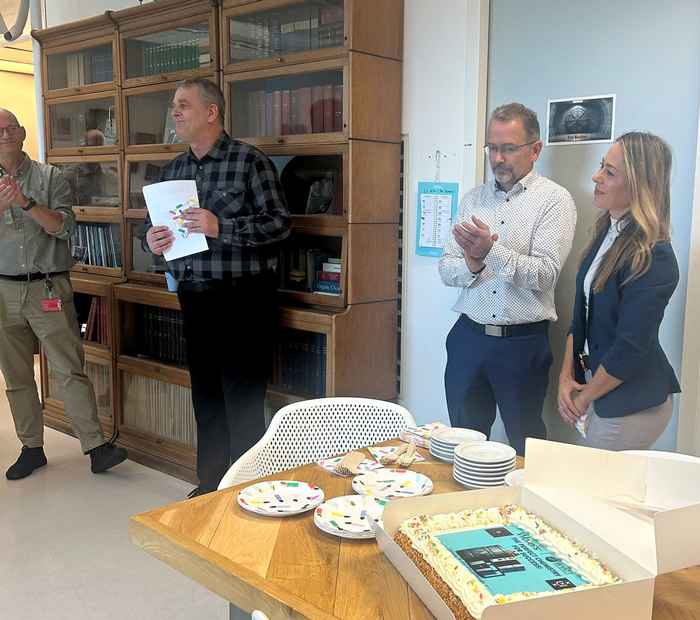
“Through her leadership, the Dutch FFF Facility and Expertise Hub has gained international recognition for pioneering work in areas including microplastics, nanoplastics, biopharmaceuticals, food science, and environmental research. Alina's ability to foster collaborations, build scientific networks, and champion innovative analytical approaches has helped establish AF4 as a powerful platform for tackling complex scientific questions.”
Astefanei explains that the new system will help meet the challenge of analysing many ‘real life’ samples that are not single molecules or uniform materials. Think for instance of lipid nanoparticles for mRNA and RNA-based therapeutics, protein drugs and biomolecular assemblies; advanced foods and sustainable materials; and emerging contaminants such as nanoplastics. “These all consist of dynamic populations of particles and aggregates that interact and evolve”, says Astefanei. “Their function, stability, efficacy and environmental impact are determined by the behaviour of those populations, not by a single average measurement. The question we want to answer is: how much of what we measure truly reflects the system as it exists in reality?”
A national reference centre for advanced characterisation
This all-important question is also central to the Dutch FFF Facility and Expertise Hub which connects researchers, industry and public organisations and accelerates the adoption of these advanced analytical methods across the Netherlands. The Hub supports joint projects and interlaboratory studies, offers shared infrastructure and method development, and provides training for students, PhD candidates, postdocs and industrial users. In this context, Astefanei hopes to establish HIMS as a national reference centre for advanced particle and biomolecular characterization. “And internationally, the new system keeps us competitive with the best facilities available and supports our ongoing collaborations and our role in large international initiatives in this field.”