Salted proteins: the molecular basis of protein halotolerance
John van Geuns Lecture
Lecture by Prof. Ana Vila Verde (University of Duisburg-Essen, Germany)
Event details from: Salted proteins: the molecular basis of protein halotolerance
- Date
- 22 June 2022
- Time
- 11:00
Abstract
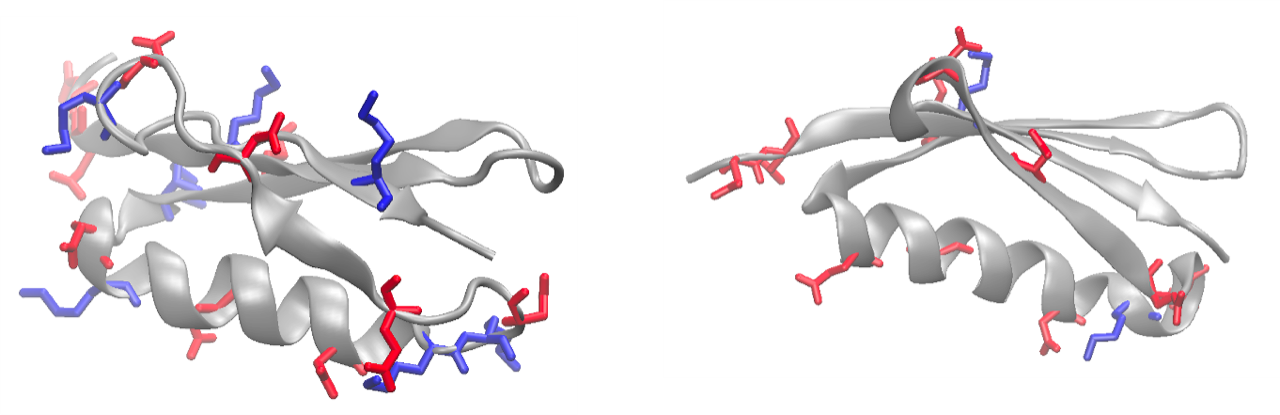
Aqueous environments like the Dead Sea, with multimolar concentrations of NaCl, are far from dead. Rather, they are rich with uni- and multicellular organisms that not only survive, but thrive, under conditions that would kill most other organisms on the planet. To counterbalance the large osmotic pressure characteristic of multimolar salt solutions, many halophilic organisms accumulate KCl in their cytoplasm also up to multimolar concentrations. The proteins of halophilic organisms are thus folded and active under KCl concentrations that would inactivate your typical set of proteins. This ability has been correlated with the unusual composition of halophilic proteins: richer in negative and polar amino acids, poorer in positive and hydrophobic amino acids relative to typical proteins. In this talk I will describe our recent work using molecular dynamics simulations to mechanistically clarify, at the atomistic level, the role played by acidic amino acids in protein tolerance to high salt concentrations. I will also summarize our force field developments for inorganic ions, indispensable to draw reliable insight from simulations, and point to future directions in this topic.
Venue
Science Park 904, lecture room G4.15
This lecture is sponsored by the John van Geuns Foundation.