HIMS Lecture 19 November 2025
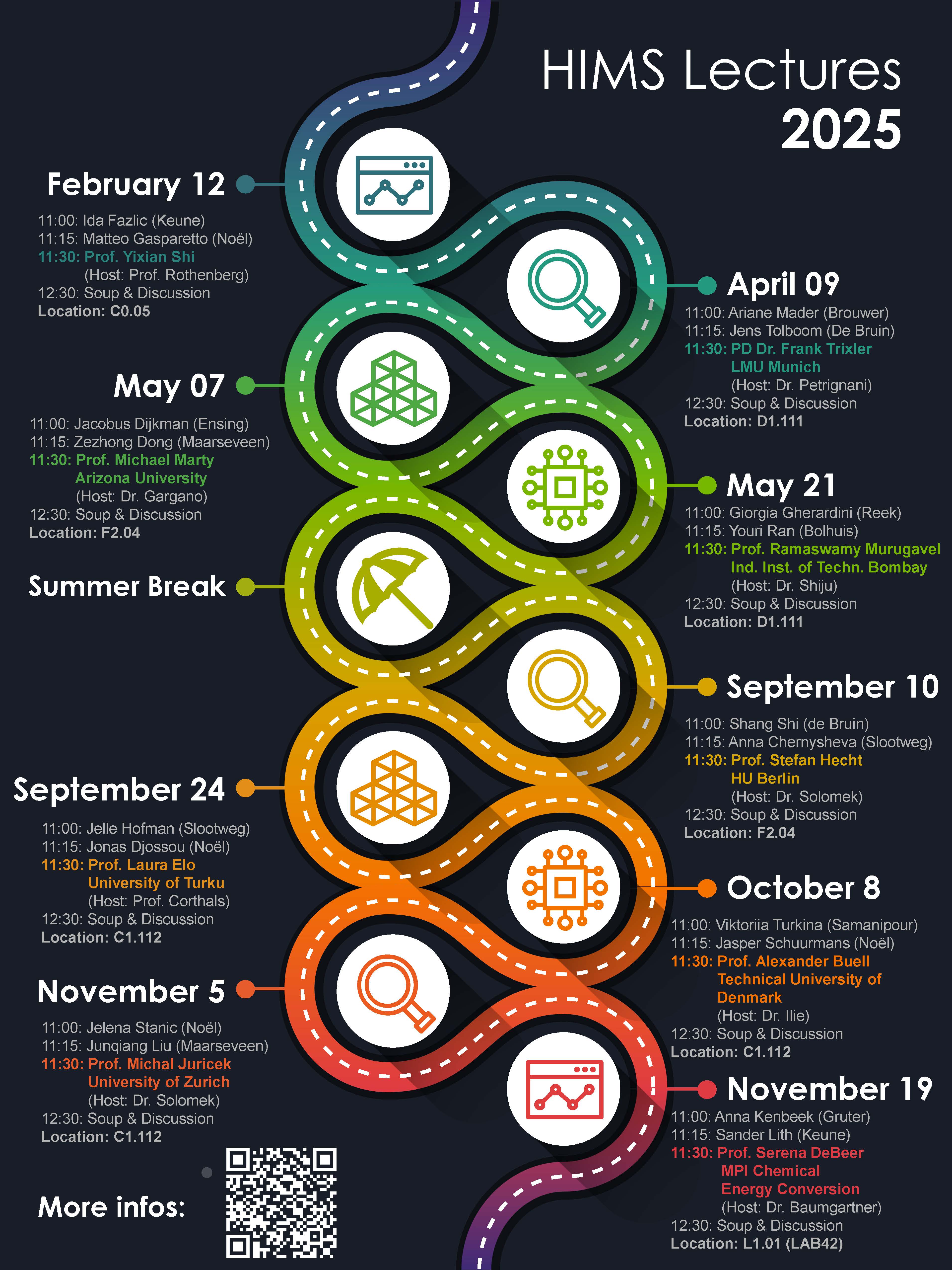
PhD presentations by Anna Kenbeek and Sander Lith. Invited speaker: Prof. Serena DeBeer (MPI Chemical Energy Conversion)
Event details from: HIMS Lecture 19 November 2025
- Date
- 19 November 2025
- Time
- 11:00 – 13:00
- Room
- L1.01
Venue
SP L1.01 (LAB42)
Host
Bettina Baumgartner
PhD lecture
11:00 - 11:30
Sander Lith (Keune group)
Title: Untangling ester hydrolysis and oxidation in aging oil paint under different humidities
Invited speaker
11:30 - 12:30
Prof. Serena DeBeer (MPI Chemical Energy Conversion)
Title: Shining Light on Nitrogen Fixation
Abstract
The nitrogenase family of enzymes is responsible for nearly all biological nitrogen fixation and has attracted intense interest for decades due to its ability to reduce N2 to NH3 under ambient conditions. The active site of nitrogenase is a MoFe7S9C cluster, the so-called iron molybdenum cofactor (or FeMoco), which is the site of substrate activation. In recent years, our understanding of the mechanism has advanced substantially, however, many open questions remain as to the specific site of reduction and protonation events during the catalytic cycle. Recently, we have shown that selective Se substitution combined with selenium Kα high-energy resolution fluorescence detected X-ray absorption spectroscopy (Se Kα HERFD XAS) can reveal a more detailed picture of the electronic structure of the active site. In the present study, we utilize a combination of electron paramagnetic resonance (EPR) and Se Kα HERFD XAS, together with extended X-ray absorption fine structure (EXAFS), to understand the mechanism of Se insertion and the nature of early intermediates in the catalytic cycle. In addition, recent spectroelectrochemical studies of a nitrogenase biohybrid system will be presented.
Bio
Serena DeBeer, PhD, is Group Leader PINK Beamline, Energy Materials In-Situ Laboratory at the Helmholtz Centre in Berlin, Adjunct Professor at the Department of Chemistry & Chemical Biology at Cornell University, and Director of the Department of Inorganic Spectroscopy at the Max Planck Institute for Chemical Energy Conversion. Her research focuses on development and application of synchrotron spectroscopies to understand fundamental questions in biological and chemical catalysis (Cornell University).