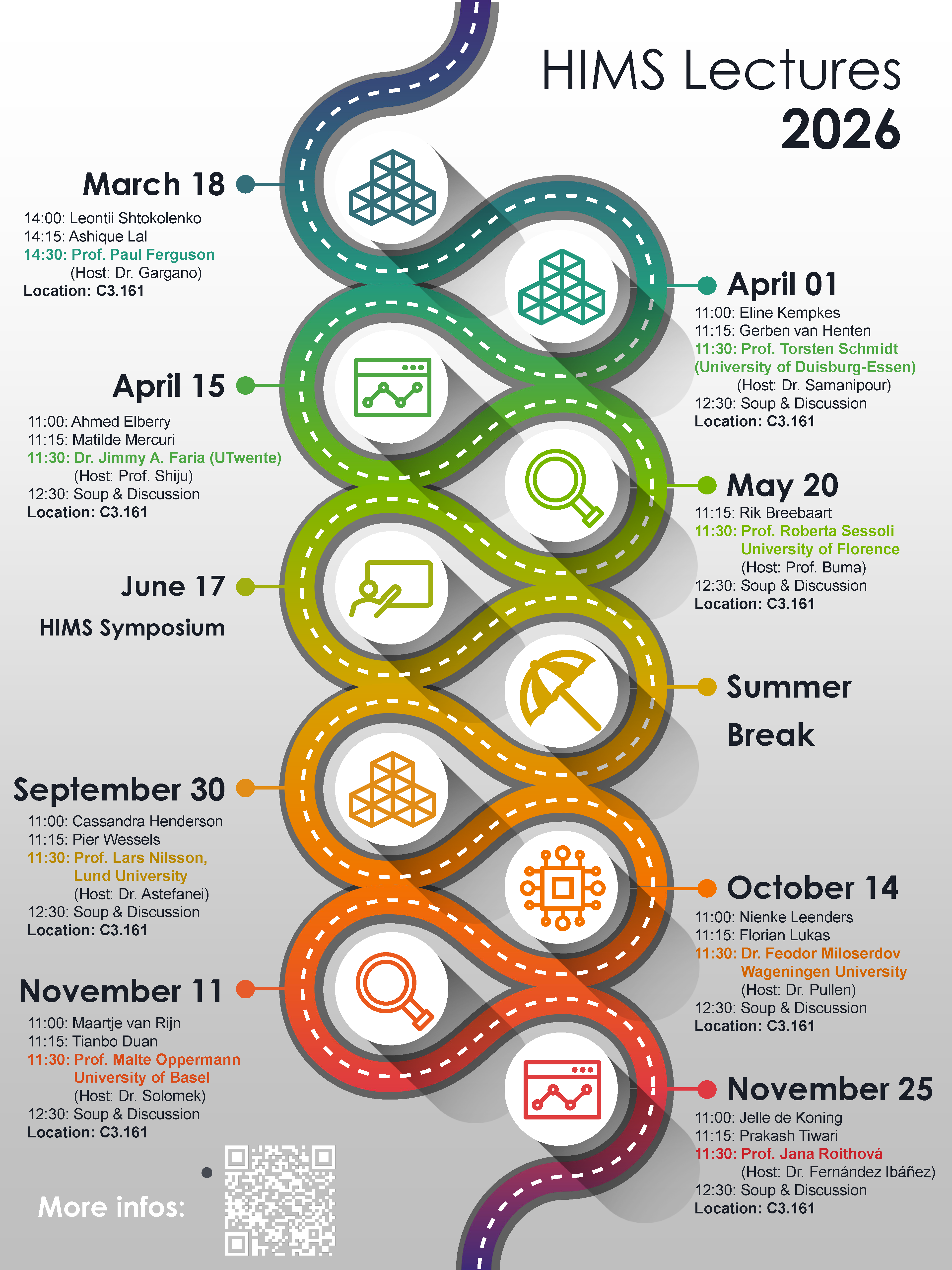
HIMS Lecture 15 April 2026
PhD presentations by Ahmed Elberry and Matilde Mercuri. Invited speaker: Dr. Jimmy Faria (University of Twente)
Event details from: HIMS Lecture 15 April 2026
- Date
- 15 April 2026
- Time
- 11:00 – 13:00
- Room
- C3.161
Venue
SP C3.161
Host
Shiju Raveendran
PhD lectures
11:00 - Lecture 1
Ahmed Elberry (van der Zwaan group)
Title: Modelling the macroeconomic impacts of the energy transition
11:15 - Lecture 2
Matilde Mercuri (Ensing group)
Title: Machine Learning Potentials for Ion Pair Dynamics in Aqueous Solutions
Invited speaker
Prof. dr. ir. Jimmy A. Faria A. (University of Twente)
Title: Dynamic Catalytic Ammonia Decomposition: A Strong Coupling between Localized Transient Heating and Reaction Kinetics
Abstract
Ammonia (NH₃) is emerging as a promising carbon-free hydrogen carrier, offering cost-effective solutions for hydrogen storage and transportation. However, recovering hydrogen from NH₃ via catalytic cracking remains energy-intensive due to the endothermic nature of the reaction. This seminar will begin by reviewing the role of ammonia as an energy storage medium in decentralized settings, focusing on its integration with renewable energy sources through an absorption-enhanced Haber-Bosch process. We will then examine the interplay between reaction kinetics and transient heating during dynamic ammonia decomposition, utilizing a custom-designed micro-reactor capable of ultra-fast thermal cycling. Dynamic operation is achieved via Joule heating of a pyrolytic graphite sheet (PGS) coated with catalyst. Rapid heating to high temperatures within milliseconds, followed by fast cooling, enables efficient NH₃ decomposition. Compared to isothermal operation at 400 °C, dynamic modulation yields turnover frequencies up to four orders of magnitude higher for hydrogen production. This enhancement underscores the critical influence of pulse amplitude, frequency, gas hourly space velocity, and cooling rate in controlling surface reaction kinetics under non-steady-state conditions. The results provide compelling evidence for a strong coupling between localized transient heating and catalytic performance, suggesting that dynamic thermal modulation can overcome conventional kinetic constraints such as those predicted by Brønsted–Evans–Polanyi relationships. These findings open new avenues for high-efficiency hydrogen production from ammonia via temporally programmed catalytic processes.
Bio
Dr. Faria is a professor at the University of Twente (The Netherlands) working in the Faculty of Science and Technology. After completing this B.Sc. in Chemical Engineering in Venezuela he moved to the University of Oklahoma (USA) to pursue his PhD with Prof. Daniel Resasco where he worked in catalytic reactions in liquid-liquid interfaces. After graduation he moved to Spain to work in the corporate R&D center of Abengoa, leading the development of technologies for hydrogen production and biomass valorization. Since his appointment at the University of Twente Prof. Faria is working on smart catalytic materials and processes for sustainable chemical conversions for the C- an N- cycles.