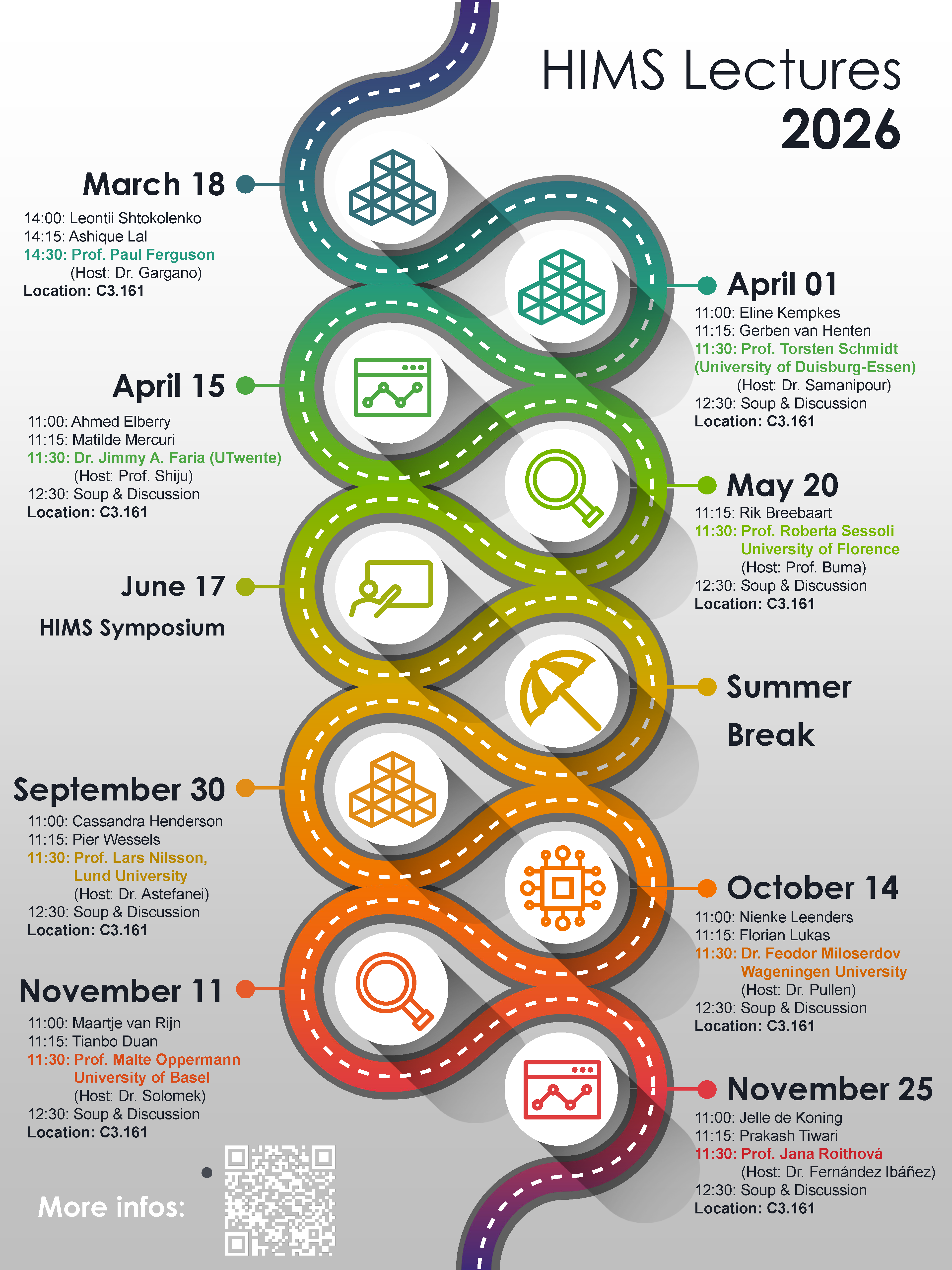
HIMS Lecture 30 September 2026
PhD presentations by Morgan Regnier and Pier Wessels. Invited speaker: Prof Lars Nilsson (Lund University)
Event details from: HIMS Lecture 30 September 2026
- Date
- 30 September 2026
- Time
- 11:00 – 13:00
- Room
- C3.023
Venue
SP C3.023
Host
Alina Astefanei
PhD lectures
11:00 - Lecture 1
Morgan Regnier (Noël group)
Title: A Practical Journey Through Flow Organic Electrosynthesis: Applications, Challenges and Future Directions
11:15 - Lecture 2
Pier Wessels (Slootweg group)
Title: One Step Mechanochemical Synthesis of Metal Borohydrides: Easy Access to Valuable Hydrogen Storage Materials
Invited speaker
Prof Lars Nilsson
Title: Resolving Hidden Heterogeneity: Connecting Structure and Function in Biomolecular Systems | From proteins and casein micelles to mRNA lipid nanoparticles
Abstract and biography
Lars Nilsson is Professor of Formulation Technology at Lund University and holds a part-time position at the MAX IV synchrotron. Working at the intersection of analytical chemistry, colloid science, pharmaceutical science and biotechnology, his research focuses on how structure and heterogeneity in complex biomolecular systems determine their properties, behaviour and function.
A central theme of Nilsson’s work is the development of multidimensional analytical approaches that move beyond conventional ensemble averages. He has played a key role in establishing the online coupling of asymmetric flow field-flow fractionation (AF4) with small-angle X-ray and neutron scattering. These approaches separate complex samples into size-resolved populations while simultaneously providing information about particle morphology and internal organisation. By revealing structural heterogeneity that would otherwise remain hidden, and linking it to functional performance, his research provides a more precise basis for understanding, designing and controlling biomolecular systems.
His recent research illustrates the breadth and potential of this approach. In mRNA-loaded lipid nanoparticles, for example, his team has identified distinct structural subpopulations and established links between particle architecture, cargo distribution and transfection efficiency. Another major area of research concerns the formation of protein coronas when nanoparticles encounter blood plasma, and how differences in corona composition and particle structure influence their subsequent biological behaviour.
Nilsson’s work addresses a central challenge in modern health and life-science research: materials that appear uniform when characterised in bulk may in fact consist of structurally distinct subpopulations with very different functions. Highly relevant to HIMS, his lecture will demonstrate how advanced separation and scattering methods can uncover this hidden heterogeneity and provide new insight into the structure–function relationships of complex biomolecular systems.