Sustainable Chemistry researchers invent novel catalyst for conversion of carbon dioxide
Catalyst enables conversion under moderate conditions
Dr Edwin S. Gnanakumar and Dr Shiju Raveendran from the Research Priority Area Sustainable Chemistry at the University of Amsterdam (UvA) have invented a new catalyst that can efficiently convert CO2 to CO, thus opening up reaction pathways for the utilization of the greenhouse gas. The university has filed a patent application on the invention and both researchers are now working further on commercializing the catalyst with the help of UvA's technology transfer office at Innovation Exchange Amsterdam (IXA).
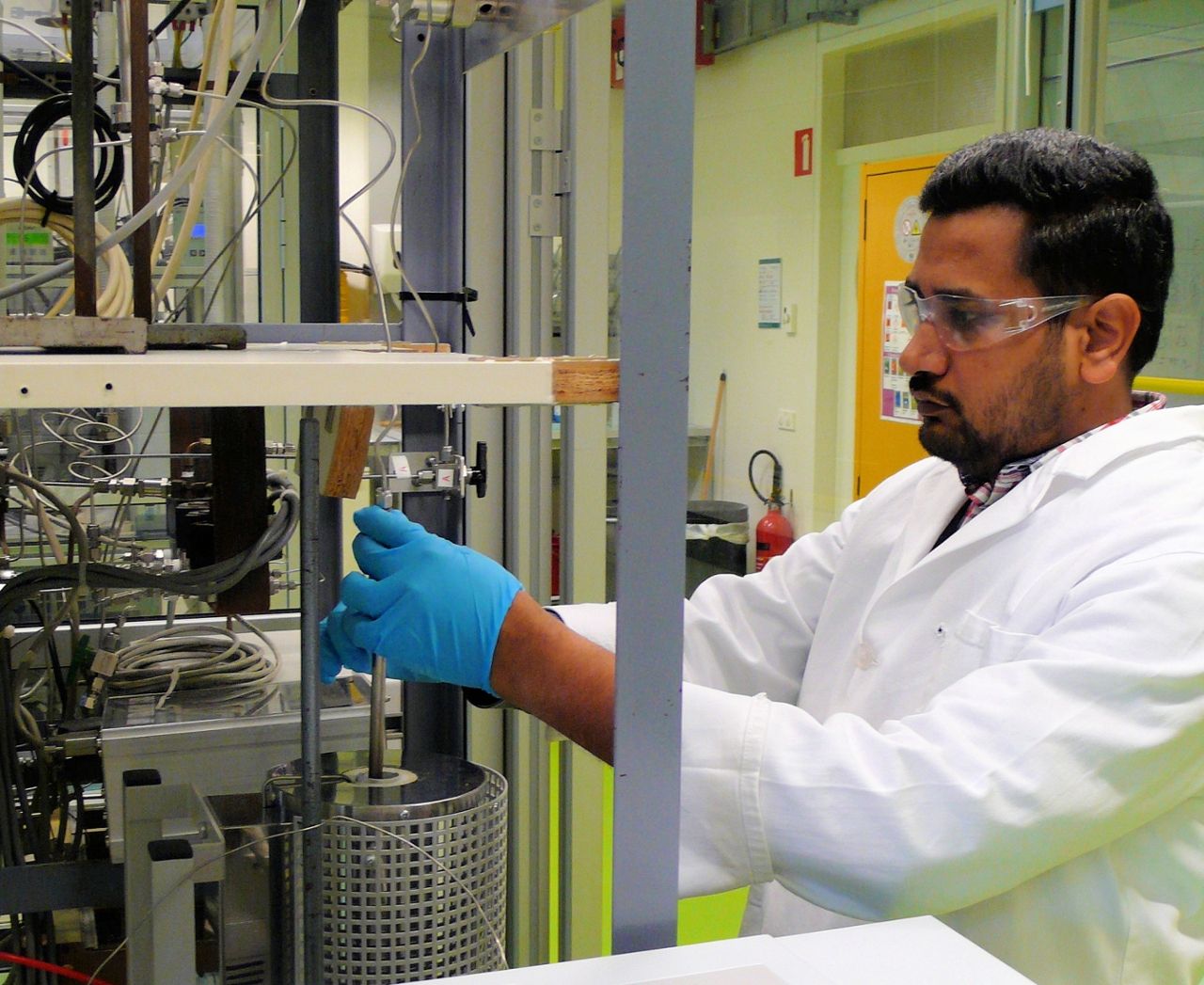
Even as politicians around the world discuss the growing problem of carbon dioxide emissions, chemists are developing practical solutions. By considering CO2 a resource rather than a waste, they are closing the CO2 cycle. However, using CO2 as a raw material, converting it to useful chemicals or fuels, is much more easier in paper than in practice. Activating and reacting CO2 is a challenge, because it is one of the most stable molecules.
Addressing the CO2 activation problem, Dr Edwin S. Gnanakumar and Dr Shiju Raveendran from UvA’s Sustainable Chemistry Research Priority Area have invented a new catalyst that can efficiently convert CO2 to CO at relatively mild conditions. Once CO is made, it can be converted it to a number of common hydrocarbons using existing technology, thus opening a new way for the utilization of CO2.
Promising scale-up perspective
The new catalyst is easily prepared and inexpensive. It can convert CO2 at ambient pressure and temperatures below 400 °C. Longer-term tests in a flow reactor confirmed that the catalyst remains active, showing promise for scale-up for applications such as industrial flue gas conversion. According to the researchers the conversion can be easily adapted for handling large amounts of gases.
The work on the CO2 catalyst is part of the framework of the European research project CAPITA (Catalytic Processes for Innovative Technology Application), co-funded by NWO. The consortium also includes the University of Castilla-La-Mancha (Spain), the Technological Educational Institute of Sterea Ellada and the Chemical Process Engineering Research Institute (Greece) as well as three companies: Hellenic Petroleum Renewables (Greece), GRAPHENANO (Spain), and Delft Solid Solutions (Netherlands).