Paper on monomers from carbon dioxide is cover feature of ChemSusChem
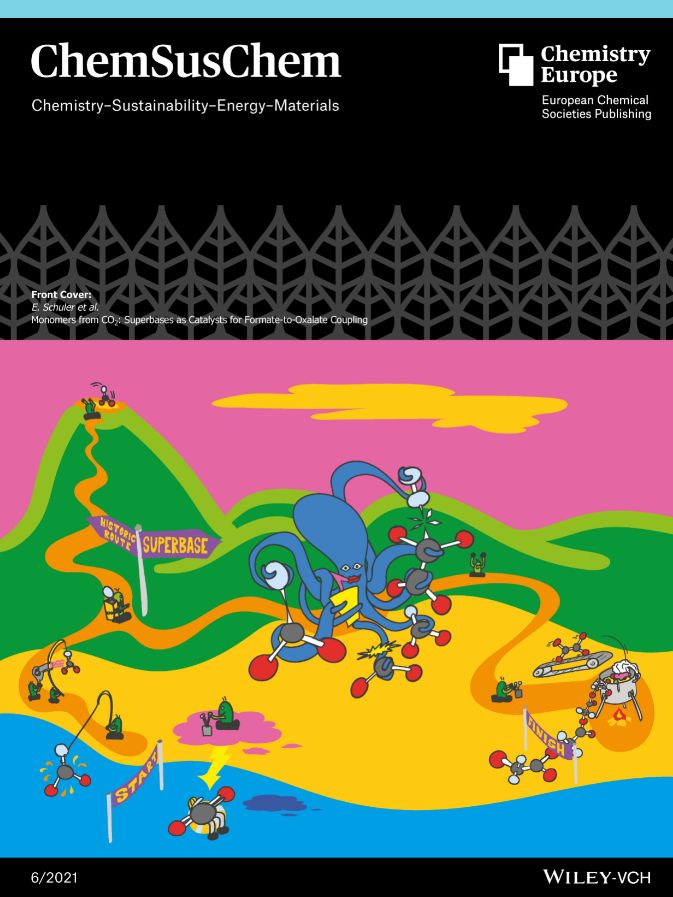
Eric Schuler illustrated the CO2‐to‐Polymers process he develops at the UvA in the EU‐funded OCEAN project.
Eric Schuler, a PhD candidate working with Prof. Gert-Jan M. Gruter and Dr Shiju Raveendran at the University of Amsterdam's Van ‘t Hoff Institute for Molecular Sciences, helps to develop a process to turn CO2 into polymers. In a recent publication in ChemSusChem, the researchers report the first major improvements of the 175-year-old formate-to-oxalate coupling reaction using superbases as catalysts. This reaction is an incremental step in the route from CO2 to polymers.

Abstract
An interesting contribution to solving the climate crisis involves the use of CO2 as a feedstock for monomers to produce sustainable plastics. In the European Horizon 2020 project “OCEAN” a continuous multistep process from CO2 to oxalic acid and derivatives is developed, starting with the electrochemical reduction of CO2 to potassium formate. The subsequent formate‐to‐oxalate coupling is a reaction that has been studied and commercially used for over 175 years. With the introduction of superbases as catalysts under moisture‐free conditions, unprecedented improvements were shown for the formate coupling reaction. With isotopic labelling experiments, the presence of carbonite as an intermediate was proven during the reaction, and with a unique operando set‐up, the kinetics were studied. Ultimately, the required reaction temperature could be dropped from 400 to below 200 °C, and the reaction time could be reduced from 10 to 1 min whilst achieving 99 % oxalate yield.
Open-access paper
E. Schuler, P. A. Ermolich, N. R. Shiju, G.-J. M. Gruter, Monomers from CO2: Superbases as Catalysts for Formate‐to‐Oxalate Coupling, ChemSusChem 6/2021,14, 1517-1523. DOI: 10.1002/cssc.202002725 (paper) 10.1002/cssc.202100327 (cover feature)
Links
Website OCEAN project
Website HIMS research group Industrial Sustainable Chemistry (prof. Gert-Jan M. Gruter)
Website HIMS research group Catalysis Engineering (Dr Shiju Raveendran)
.