Integrating the power of photons and electrons
A novel flow reactor for electrophotocatalysis
In a VIP paper in Angewandte Chemie, researchers of the Van ‘t Hoff Institute for Molecular Sciences at the University of Amsterdam present a novel flow reactor for electrophotocatalysis (EPC) that uniquely integrates the power of photons and electrons. It was developed in a cooperation between the groups of Homogeneous, Supramolecular and Bio-Inspired Catalysis (Prof. Joost Reek) and Flow Chemistry (Prof. Timothy Noël). The reactor represents a significant advancement in electrophotocatalysis, providing a framework for its application in flow for complex synthetic transformations.
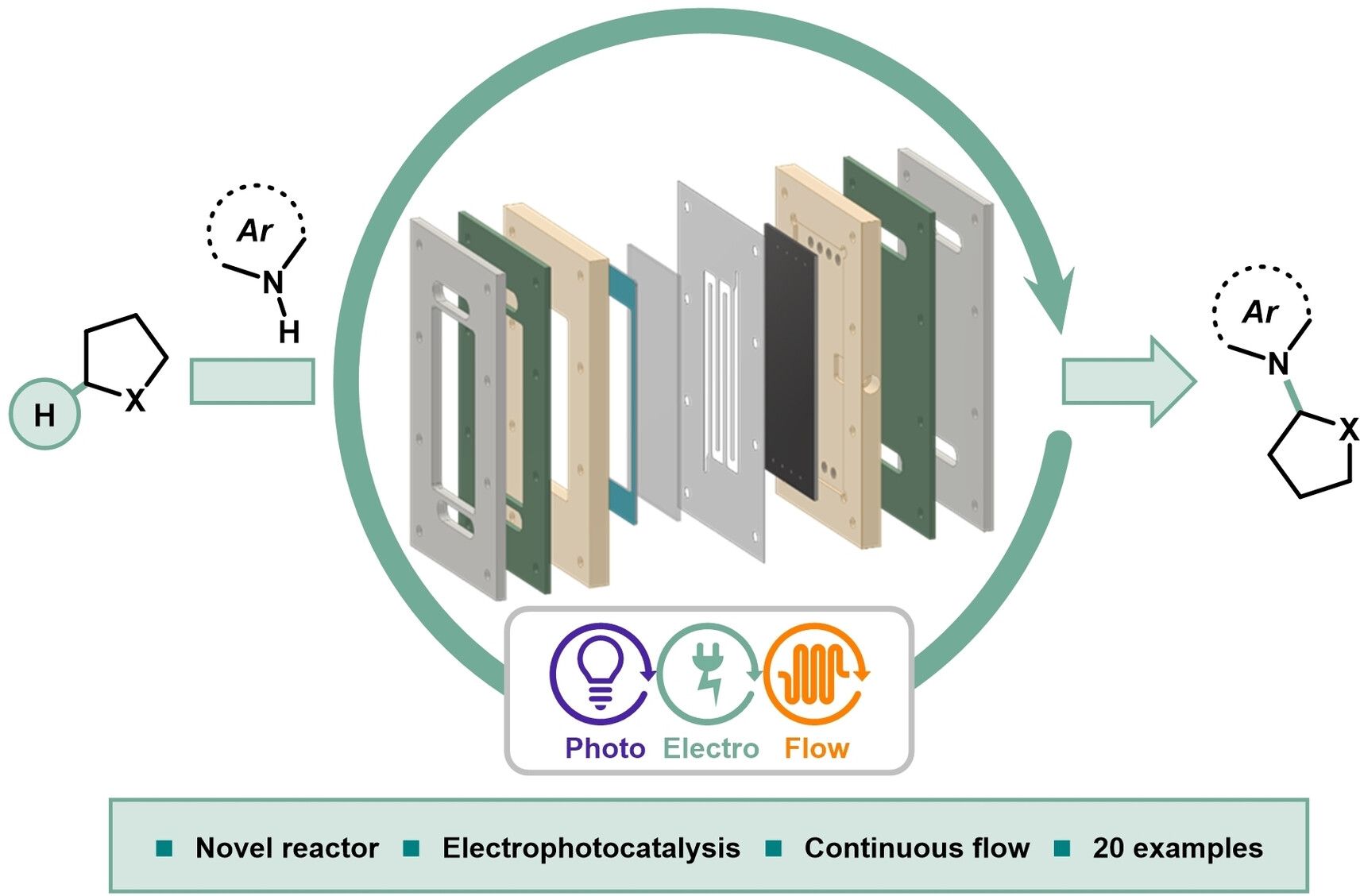
The design of the novel reactor features a transparent electrode and utilizes cost-effective materials. It not only enhances irradiation and improves mixing but also significantly increases the electrode surface area. Led by first author Dimitris I. Ioannou, a PhD student working at both contributing research groups, the reactor was used to develop an efficient process for electrophotocatalytic heteroarylation of C(sp3)–H bonds. Importantly, the same setup can also facilitate purely electrochemical and photochemical transformations.
Abstract of the paper
Electrophotocatalytic transformations are garnering attention in organic synthesis, particularly for accessing reactive intermediates under mild conditions. Moving these methodologies to continuous-flow systems, or flow ElectroPhotoCatalysis (f-EPC), showcases potential for scalable processes due to enhanced irradiation, increased electrode surface, and improved mixing of the reaction mixture. Traditional methods sequentially link photochemical and electrochemical reactions, using flow reactors connected in series, yet struggle to accommodate reactive transient species. In this study, we introduce a new flow reactor concept for electrophotocatalysis (EPC) that simultaneously utilizes photons and electrons. The reactor is designed with a transparent electrode and employs cost-effective materials. We used this technology to develop an efficient process for electrophotocatalytic heteroarylation of C(sp3)−H bonds. Importantly, the same setup can also facilitate purely electrochemical and photochemical transformations. This reactor represents a significant advancement in electrophotocatalysis, providing a framework for its application in flow for complex synthetic transformations.
Paper details
Dimitris I. Ioannou, Luca Capaldo, Jiri Sanramat, Joost N. H. Reek, Timothy Noël: Accelerated Electrophotocatalytic C(sp3)−H Heteroarylation Enabled by an Efficient Continuous-Flow Reactor. Angew. Chem.Int. Ed. 2023, e202315881, 16 November 2023. DOI: 10.1002/anie.202315881
See also
- Research group Flow Chemistry
- Research group Homogeneous, Supramolecular and Bio-Inspired Catalysis