The multifaceted roles of metal-organic cages in catalysis
In an invited review article in Nature Synthesis, postdoctoral research associate Dr Zoe Ashbridge and Prof. Joost Reek of the research group Homogeneous, Supramolecular and Bio-Inspired Catalysis describe the potential of metal-organic cages, in particular of the MnL2n type, in catalysis.
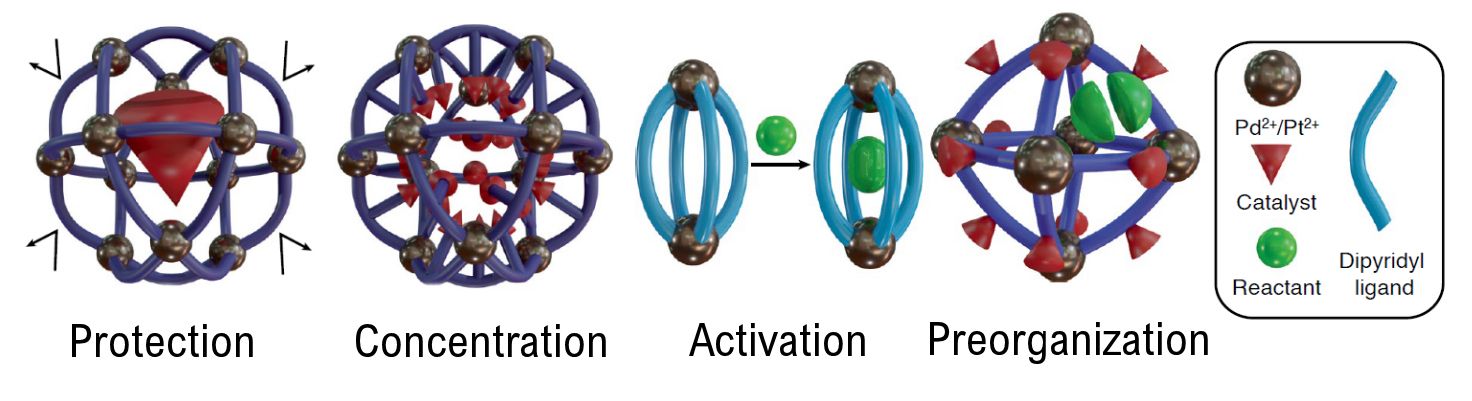
With their review, Ashbridge and Reek highlight the multifaceted role of cage catalysts and advocate the use of these readily accessible, robust and versatile catalysts as an ubiquitous choice for mediating synthetic reactions. By summarising and listing the available literature, they demonstrate the potential of caged catalysts to provide unique reactivity and improved spatial and temporal control in a diverse range of catalytic processes, at times even emulating the highly complex nature of enzyme active sites.
Although their review focuses on MnL2n cage systems - including important concepts developed at their own research group - they expect that this potential also applies for other metal–organic and even purely organic cage architectures. Thus, with important advances in synthesis and application already demonstrated in recent years, it is very possible that metal–organic cages may soon assume a routine role in synthetic chemistry.
Abstract, as published with the paper
Metal–organic cages are versatile supramolecular architectures, fulfilling various distinct roles in the mediation of catalysed chemical reactions. MnL2n cages have become increasingly synthetically accessible in recent years, and their modular nature allows for precise tailoring for specific applications. Sophisticated MnL2n cages have now been deliberately designed to fulfil several roles, providing unique reactivity that begins to emulate the highly complex nature of enzyme active sites. Here we highlight the different functions played by MnL2n cages in the context of catalysed synthetic reactions: (1) protection of catalysts or substrates, (2) activation or preorganization of guests and (3) concentration enhancement of reactants or catalysts in confined space. We conclude by discussing future directions for the field, such as the potential to increase complexity further by developing stimuli-responsive, flexible or reduced-symmetry cages, ultimately progressing artificial cage catalysis towards the levels of catalytic control provided by biological host–guest architectures.
Paper details
Zoe Ashbridge & Joost N. H. Reek: The multifaceted roles of MnL2n cages in catalysis. Nat. Synth. (2024). DOI: 10.1038/s44160-024-00606-5