ChemistryNL funding for study of electrochemical CO₂ conversion under real-life conditions
Dr Amanda Garcia at the Van ‘t Hoff Institute for Molecular Sciences (HIMS) has been awarded €450,000 funding by ChemistryNL for research in cooperation with the company Brineworks. The awarded project aims to improve the practical relevance of novel technology for electrochemical conversion of carbon dioxide.
The funding was awarded as part of the 2026 call for Public-Private Partnership Innovation (PPP-I) where ChemistryNL supports collaboration on key technological and societal challenges. By bridging the gap between mechanistic understanding and practical implementation of CO₂ conversion technology, the project takes a crucial step towards realising a circular chemical industry and a more sustainable society
Developing a robust technology
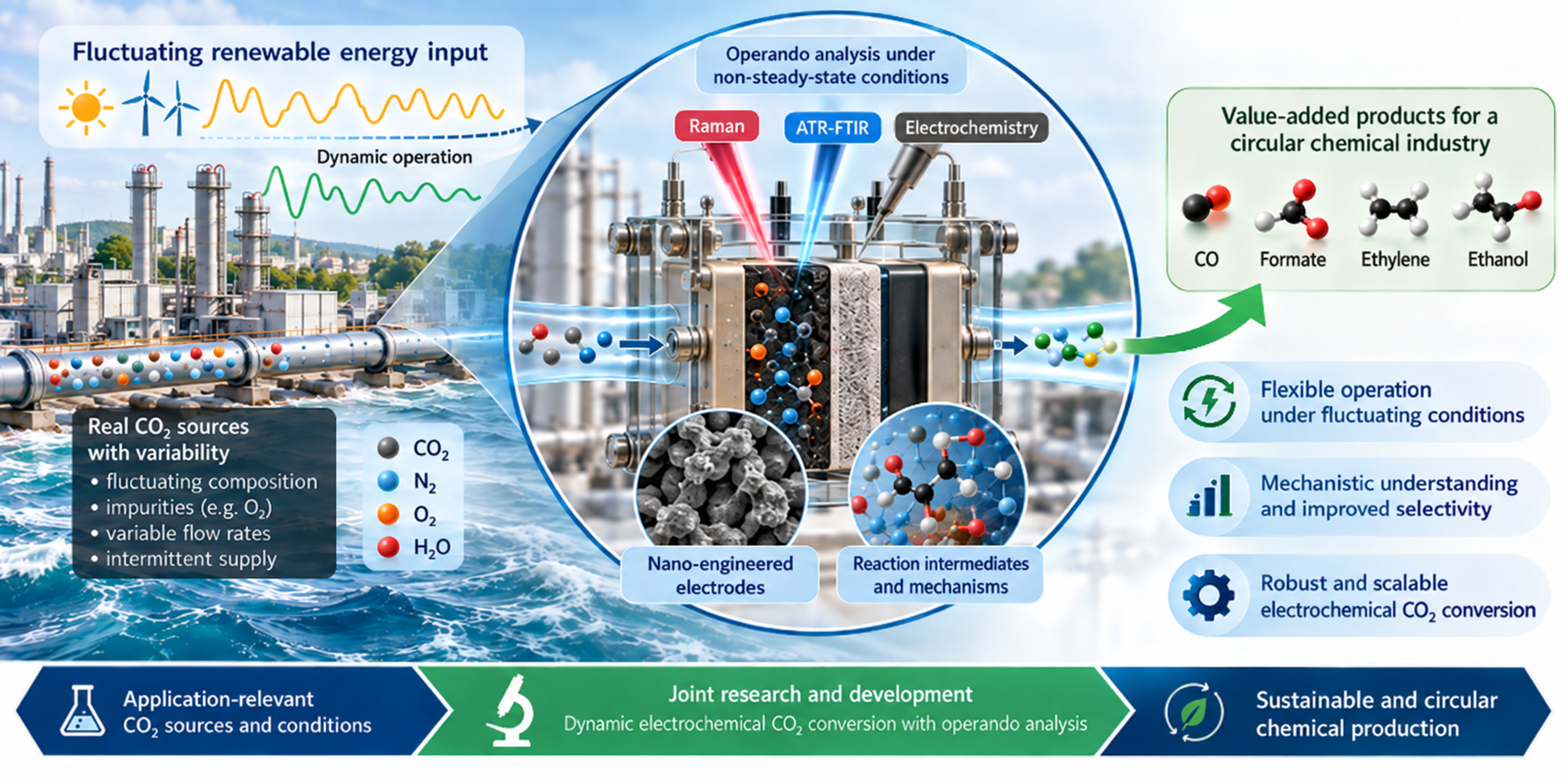
Current systems for electrochemical CO₂ conversion are most often studied under idealised steady-state conditions, employing a controlled flow of pure CO2. In practice though, CO₂ supply is often intermittent and may contain impurities such as O₂. This can strongly affect reaction pathways, selectivity, catalyst stability, and overall process efficiency.
Understanding these phenomena is crucial to the development of a robust technology that is ready for industrial application. The newly funded project addresses this challenge through the collaboration between researchers led by Dr Amanda Garcia at HIMS (research group Heterogeneous Catalysis and Sustainable Chemistry) and Brineworks, a company at Amsterdam Science Park developing CO2 capture and conversion technology.
Advanced analysis and pilot-scale operation
At HIMS, advanced electrochemical methodologies and operando spectroscopic techniques will be developed and applied to systematically investigate dynamic CO₂ electroreduction under controlled conditions. Time-resolved electrochemical analysis, combined with Raman and ATR-FTIR spectroscopy, will enable identification of transient intermediates and elucidation of reaction mechanisms under fluctuating operation.
Brineworks will provide access to application-relevant CO₂ supply systems, including a lab-scale setup capable of delivering true intermittency under realistic constraints, as well as pilot-scale operation enabling stable, high-flow CO₂ supply. The latter will be conducted on-site, ensuring that validation is performed under realistic system configurations and operational constraints. This allows direct validation of the identified operating conditions under both intermittent and steady-state regimes.
Bridging the gap
Through iterative feedback between controlled laboratory studies and real-system testing, the project will bridge the gap between mechanistic understanding and practical implementation. Ultimately, the project will establish design principles for flexible electrochemical processes that can operate reliably under variable CO₂ supply and renewable energy input.
See also