Direct evidence for the role of silver salts in oxidative addition
Researchers led by Dr Tati Fernández-Ibáñez at the Van ‘t Hoff Institute for Molecular Sciences have discovered that silver salts can actively promote the oxidative addition step in palladium-catalysed C–H arylation reactions. They explain this previously unrecognised role of silver in a paper in Advanced Synthesis & Catalysis.
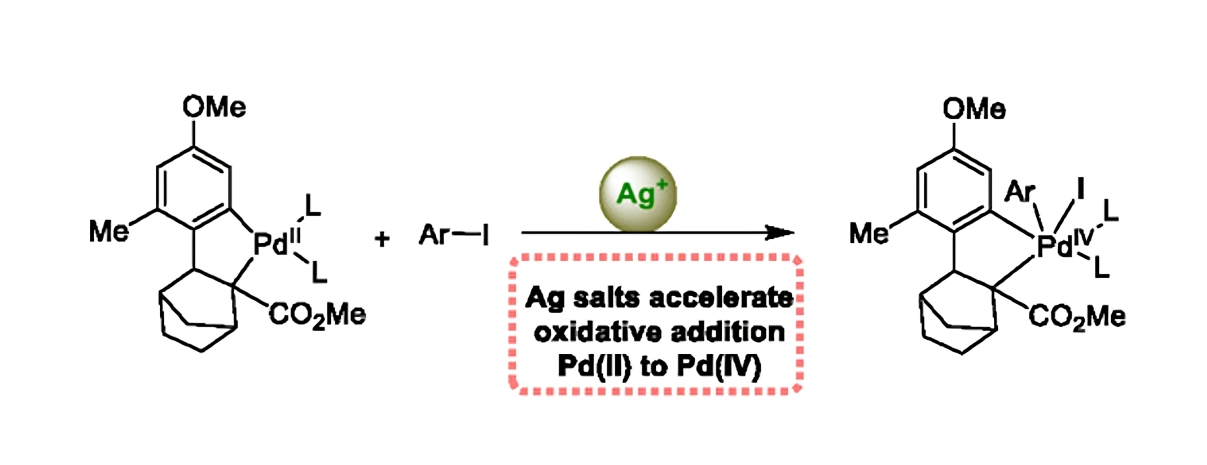
Oxidative addition is a key step in many catalytic transformations. The new insight in the role of silver not only advances fundamental understanding. It may also guide the future design of more sustainable processes, potentially reducing the need for stoichiometric amounts of silver.
The findings result from follow-up research of the Fernández-Ibáñez group after an experimental observation that belied conventional expectation. Silver salts are commonly used in C-H functionalisation processes, but mostly as halide scavengers or terminal oxidants. Interestingly, in reactions where silver was initially thought to be unnecessary, the researchers repeatedly observed that efficient reactivity depended on its presence. This unexpected finding prompted a deeper mechanistic investigation.
The findings now presented in Advanced Synthesis & Catalysis reshape the general understanding of the role of silver in catalysis. In particular, the researchers’ journey from unexpected observation to mechanistic clarification contributes to the field of C–H functionalisation.
Abstract, as published with the paper
Silver is a widely used additive in Pd-catalysed C−H arylation reactions with aryl halides, which compromises the overall sustainability of the processes. The role of silver in these transformations has been attributed to its ability to act as a halogen scavenger to regenerate the active catalyst. However, the possibility of silver playing other roles has been widely questioned, as replacing silver salts with other halogen scavengers has proven challenging. In this work, we provide experimental evidence demonstrating the role of silver as a promotor of the rate-limiting oxidative addition step of Pd(II) to Pd(IV) with aryl iodides, a role that, until now, has not been experimentally established. These findings are further supported by density functional theory (DFT) calculations.
Paper details
Verena Sukowski, Soma P. Rudi, María L. G. Sansores-Paredes, Bas de Bruin, M. Ángeles Fernández-Ibáñez: Direct Evidence for the Role of Silver(I) Salts in Promoting the Oxidative Addition Step in Palladium-Catalyzed C−H Arylation Reactions. Advanced Synthesis & Catalysi 368, 3, e70275. DOI: 10.1002/adsc.70275