How machine learning and digital twins accelerate photoreactor development
From days in the lab to minutes on the computer
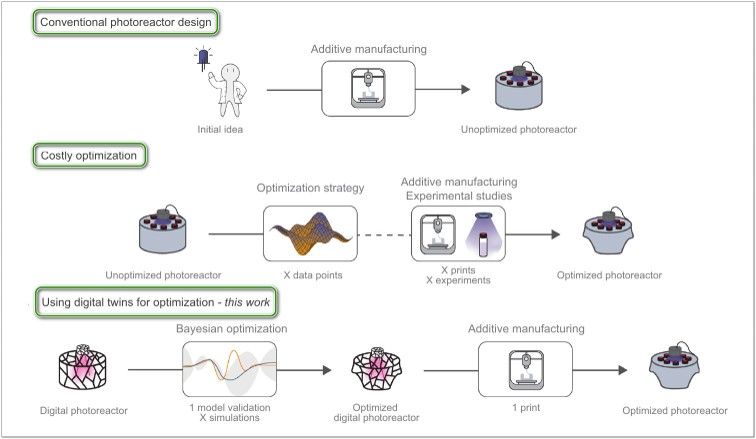
In a paper that has just been published by Nature Communications, researchers at the Flow Chemistry group led by Prof. Timothy Noël present a new approach towards the design of photoreactors. Combining digital twins and Bayesian optimization, they are able to optimise such reactors entirely ‘in silico’. This significantly shortens development time and reduces the amount of waste generated during 3D printing.
Comparing workflows for photoreactor design. The conventional approach relies on intuition and requires slow and resource-intensive optimisation since each geometry must be fabricated and experimentally characterized. The digital-twin integrated workflow enables rapid exploration of reactor geometries and efficient use of materials. Image: HIMS / Nat Commun.