How molecular modulators reshape α-synuclein phase transitions
Towards the design of molecules that might prevent pathological protein behaviour
A computational study led by Dr Ioana M. Ilie at the University of Amsterdam’s Van ’t Hoff Institute for Molecular Sciences reveals how the phase transitions of α-synuclein, a protein associated with Parkinson’s disease, can be selectively reshaped using molecular modulators such as peptides. Published in The Journal of Chemical Physics, the study connects modulator affinity and concentration to the pathways and kinetics of the phase transitions and the emerging structure of the protein assemblies. The study thus aids the design of modulators that can stabilize dynamic, disordered protein states, or limit fibril growth.
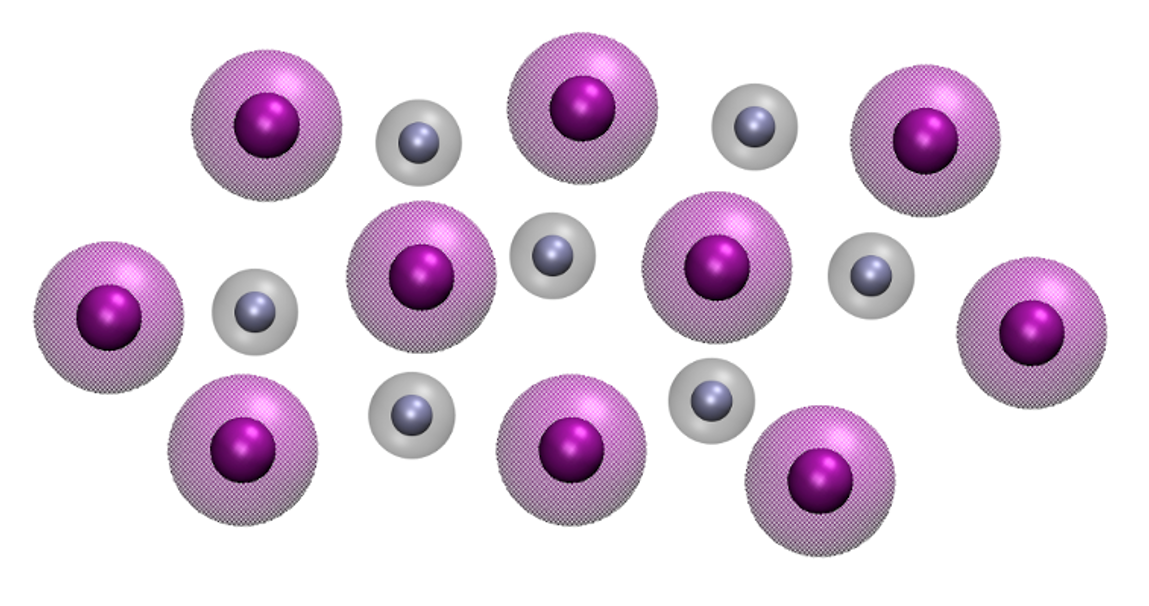
α-Synuclein proteins can adopt different conformations and assemble into various structures that range from disordered, liquid-like clusters to ordered, rigid fibrils that are rich in β-sheets and prone to pathological amyloid plaque formation. Specific molecules, such as peptides, modulate the transitions between these phases. The targeted design of these modulators can thus offer a means to prevent or suppress pathological protein behaviour. However, this requires a thorough understanding of their action, identifying which protein states are stabilized, how these interconvert and which pathways become accessible using modulators.
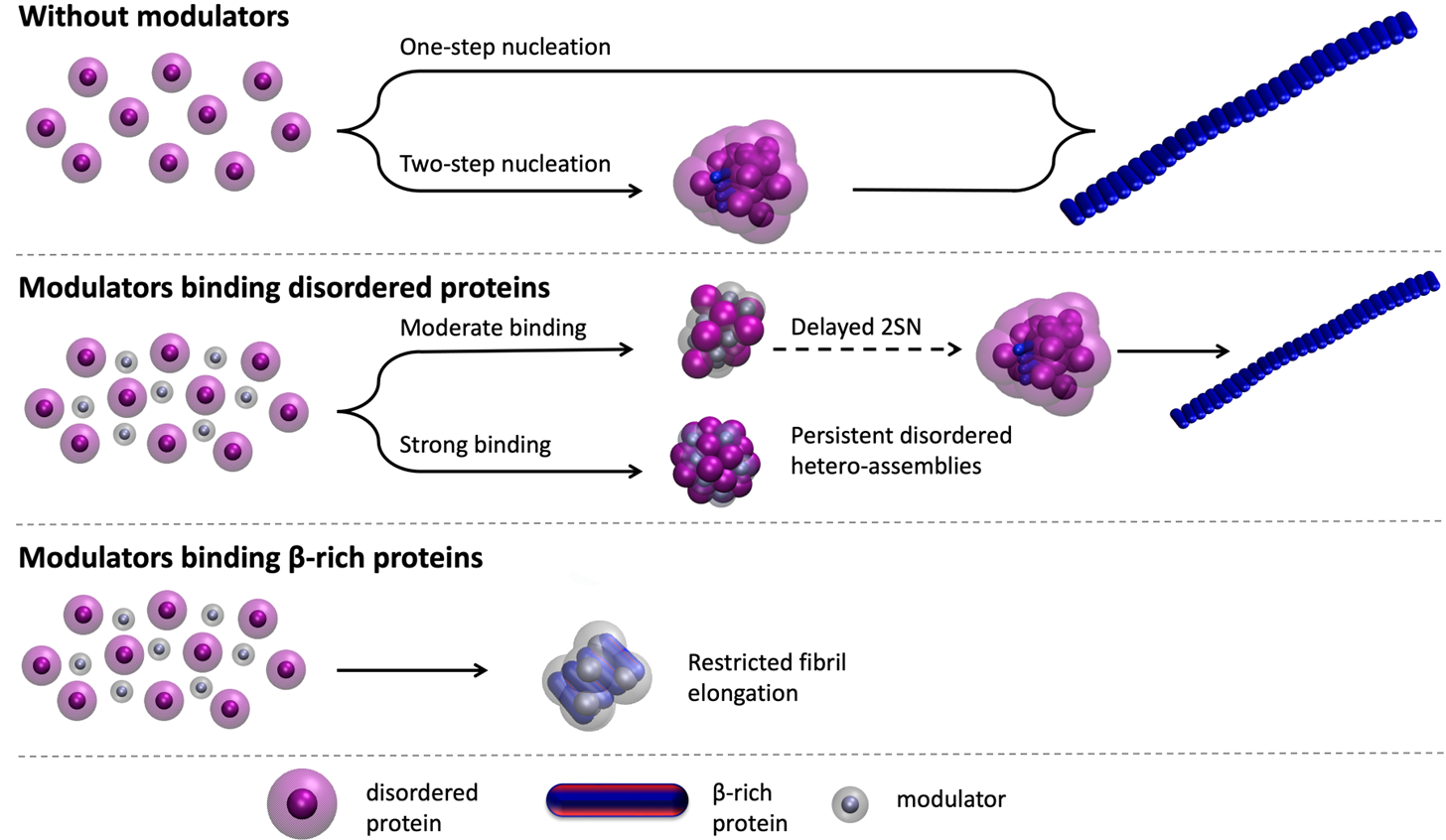
MSc student Holly Masson, PhD student Massimiliano Paesani and group leader Ioana M. Ilie investigated these questions using coarse-grained Brownian dynamics simulations. In their model, the central, aggregation-prone region of α-synuclein is represented as a morphing particle that can change from a soft sphere into an elongated particle with directional interactions. The soft sphere represents the disordered state, the elongated particle the ordered, β-rich state. Peptide-like modulators are represented as additional particles whose concentration and affinity for either protein state can be varied independently.
Binding preferences redirect phase-transition pathways
The simulations reveal two distinct modes of modulation. In one mechanism, attraction to disordered α-synuclein allows modulators to bridge proteins into dynamic, mixed assemblies. At intermediate conditions, these assemblies persist longer before converting into fibrils, extending the so-called lag phase. At stronger attraction and higher modulator concentration, persistent disordered heteroassemblies sequester proteins and dominate over the simulated timescale. Thus, in this mechanism modulators change not only the timing of fibril formation but also the balance between disordered and ordered protein states.
Modulators that preferentially bind β-rich states act through a different mechanism. They accumulate on fibril surfaces, including the ends, and hinder the incorporation of incoming proteins. This surface capping limits elongation and produces shorter fibrils. Purely repulsive modulators, by contrast, do not change the final fibrillar outcome under the conditions studied.
From physical mechanisms to molecular design
In short, the study provides a physics-based, mechanistic computational framework that links modulator properties to protein behaviour. It describes nucleation, stabilization of intermediate species, off-pathway trapping and fibril growth. The framework can thus facilitate the design of peptide-based modulators with different objectives: stabilizing disordered assemblies, delaying their conversion into β-rich structures, or limiting the growth of existing fibrils. It should be noted, however, that persistent disordered clusters and shorter fibrils cannot automatically be assumed to be less harmful. Subsequent experimental evaluation should therefore establish the biological effects of the proposed modulations.
The framework also offers opportunities beyond the field of disease-related proteins. It could, for instance, be extended to functional systems such as silk and oat proteins, which also undergo disorder-to-β-rich transitions. Controlling these transitions and the subsequent formation of protein assemblies could help guide the design of protein-based materials with tunable properties.
Publication details
Holly Masson, Massimiliano Paesani and Ioana M. Ilie: Modulators selectively reshape α-synuclein phase transitions. J. Chem. Phys. 165, 144904 (2026) DOI: 10.1063/5.0354094
See also
Research group Multiscale Simulations of Biomolecular Systems