Constructing graphene nanostructures via radical cascades
19 May 2026
The research was performed in a collaboration between the groups of Prof. Michal Juríček at the University of Zürich (Switzerland), Dr Sabine Richert at the University of Freiburg (Germany), and Dr Tomáš Šolomek at the University of Amsterdam’s Van ’t Hoff Institute for Molecular Sciences.
The relevance of the precise, extended carbon nanostructures created by the researchers lies in their potential applications in molecular electronics, energy storage, catalysis, and quantum technologies. The key challenge is that these applications critically depend on the precise atomic arrangement of the carbon nanostructures. Achieving a sufficiently high level of precision in large-scale architectures thus represents a major challenge in their synthesis.
Harnessing the reactivity
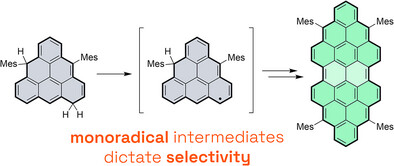
The work now published in Angewandte Chemie provides a means to do so by harnessing the reactivity of π-radicals. Being highly reactive species, they possess an untapped potential as powerful synthetic tools, forming multiple new bonds and molecular rings in a single synthetic step. On the downside, their reactivity is difficult to control, leading not only to the desired products but also to many undesired outcomes. The paper describes how to control their behaviour in reactions, thus harnessing the reactivity of open-shell molecular graphene fragments as a step-economic and synthetically valuable tool for constructing carbon nanostructures.
Šolomek performed the computational analysis to help explain the reaction mechanism, identifying monoradical intermediates as the key species determining selectivity. By tuning steric effects in a triangulene precursor, the researchers were able to demonstrate how the reactivity can be rationally guided and controlled. Furthermore, the paper establishes how these principles can be extended to even larger systems to reach complex, yet atomically precise nanostructures.
Abstract, as published with the paper
Open-shell molecular graphene fragments represent versatile synthons of graphene-based carbon nanostructures because of their ability to undergo multi-step π-radical cascades that enable the formation of multiple bonds and rings in a single step. However, the use of graphene-based π-radicals in synthesis remains limited due to our incomplete understanding of their reactivity. This limitation primarily arises from the inherent difficulty of controlling reactions involving multiple reactive centers, as is the case with π-delocalized radicals.
To address this challenge and advance research on π-radical reactivity, we establish reaction control in a system that can formally feature multiple unpaired π-electrons. Specifically, we examine oxidative peri-fusion of the dihydro-precursor of the prototypic non-Kekulé hydrocarbon triangulene. By investigating the reactive intermediates that dictate selectivity, we demonstrate that monoradical, rather than diradical, intermediates play a key role. Through the precise placement of steric bulk around the periphery, we modulate reactivity at specific positions, steering selectivity toward doubly or singly peri-fused dimeric products.
Our study demonstrates that, when controlled, the reactivity of open-shell molecular graphene fragments can serve as a step-economic and synthetically valuable tool.
Paper details
Paula L. Widmer, Leoš Valenta, Maximilian Mayländer, Jules Hutter, Francis J. Carta, Simon Jurt, Olivier Blacque, Laurent Bigler, Sabine Richert, Tomáš Šolomek, Michal Juríček: π-Radical Cascades to Peri-Fused Triangulene Dimers. Angewandte Chemie International Edition, Early View, e6610209. DOI: 10.1002/anie.6610209