Artificial Intelligence will change chemistry forever
Society will benefit, but there are concerns to be addressed
17 June 2026
In his lecture, Ensing explained how the AI models he and his colleagues are developing will radically transform the field of chemistry. By automating experiments, speeding up computer simulations, and generating new molecules and materials with desired properties. “I have no doubt that AI in chemistry will be of great help in creating a circular economy and a sustainable and healthy planet”, he said.
On the other hand, he expressed some worries: “I am for the first time concerned with how I can avoid that my models can be used to do harm”, he said. “For example, by generating molecules for explosives or new synthetic drugs. We have to be aware of how dangerous our models can be in the hands of malicious individuals.” He also expressed concerns about the use of tools such as ChatGPT by students, and even about the future of PhD research. Since AI models produce results that match those of PhD candidates, but cheaper and faster, the question arises of how to train the future generations of expert researchers.
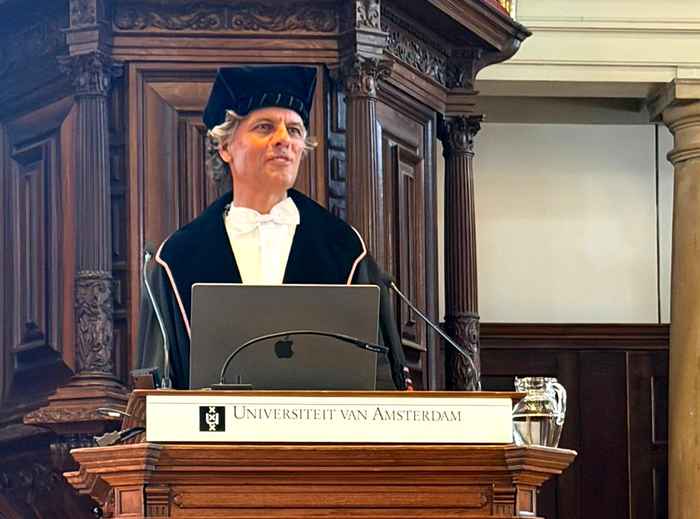
And there are, of course, general concerns about AI, such as the role of Big Tech, the growing gap between the privileged and the less privileged, and the impact on energy consumption and the economic system. Ensing: “I am committed to playing a proactive role to address these concerns at the university. When I teach my students; when I can take an advisory role for media, policy makers, and politicians; and when exchanging ideas with my colleagues working in AI, in our AI4Science and MMD Tech Hub consortia.”
We need better chemistry
Focusing the greater part of his lecture on “How artificial intelligence will help us to do better chemistry”, Ensing provided his audience with an in-depth introduction of the field of AI for Chemistry. Better chemistry is urgently needed, he stated, since there are quite a few societal problems where chemistry is key to finding solutions. “We can help combat global warming by developing new materials that can filter carbon dioxide from the air - so that we store it or even convert it into something useful."
Chemists will have to develop alternative synthesis routes for producing aviation fuels, plastics and many other products.
"At the same time, we need to develop alternatives for current chemical processes that emit lots of carbon dioxide to the atmosphere. Think of making the cement for concrete, or the ammonia to produce fertilisers. It is also crucial to stop using fossil feedstocks such as crude oil to make products. Chemists will have to develop alternative synthesis routes for producing aviation fuels, plastics and many other products.”
And the list goes on. Think of making materials for better batteries, to store energy from wind and solar plants. Or for converting solar energy into hydrogen. Chemists are also developing alternatives for materials that contain the polluting PFAS compounds and materials that degrade into micro-plastics. And we need better chemistry to develop new medicines against cancer, Alzheimer's, and many other diseases. “In short, we need better chemistry for a more sustainable planet and a circular economy, especially for our children and the next generations.”
Can artificial intelligence help with all that, and if yes, how?
Ensing acknowledged that chemists are in fact always working on new materials and new synthesis recipes. The thing is, he argued, that this is far from easy. Chemist usually start with a hunch or intuition, based on their knowledge and experience. Then they explore potential solutions using high-throughput experiments, or employing a small army of Master’s and PhD students. The most promising results are then further investigated and optimised.

This is a time-consuming endeavour that demands a great deal of effort and time both in academia and industry. So given that AI is everywhere nowadays - we all know ChatGPT and the like – could this potentially help chemistry? Yes, it can, according to Ensing. In fact, there’s already a ChatGPT for chemistry. And there are more ways to speed up chemical discovery/development using AI.
But first, a warning. Ensing highlighted a significant shortcoming in chemical science that is holding back the success of AI in discovering new chemical compounds. In general, for most chemical subjects, there are no internet-scale databases available containing AI-ready data samples. There are many chemistry journals containing huge amounts of research results. But since laboratories all over the globe have their own habits and procedures that are seldom communicated, these data are very heterogeneous and noisy.
Equally important is the fact that chemists, as so many scientists, hardly ever report about their failures. While for AI training, these negative results are super important. They help prevent the algorithm from presenting impossible synthesis routes that have no practical value.
Plenty of opportunities; three examples
Fortunately, even with the outlined shortcomings, there are still plenty of opportunities to take advantage of AI in chemical research. Ensing provided three examples of how AI can speed up chemical research and even help with obtaining better datasets.
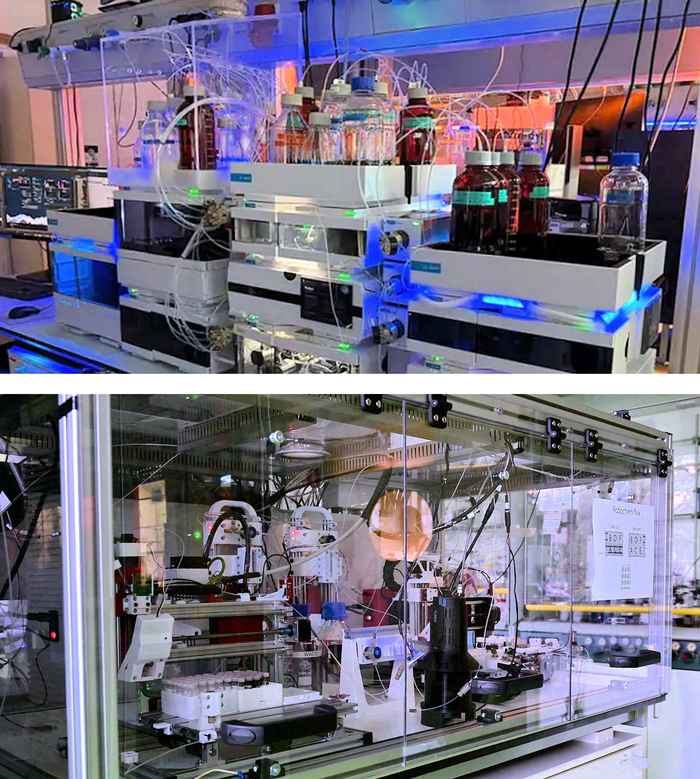
The first example is in automating repetitive laboratory experiments using a method called Bayesian optimisation. A large part of improving synthesis experiments involves optimising the reaction conditions to obtain the highest yield of product molecules. This involves finding the best temperature, pressure, solvent, reactant concentrations and other parameters. Bayesian optimisation is a method that helps to explore uncharted reaction conditions, building on available knowledge, even when only a few results are known. “Different from neural networks, which are known to require a lot of data for training, Bayesian optimisation also works with only a few data samples”, Ensing explained. “And while more data is obtained, the method ‘homes in’ on the optimal outcome.” He pointed out two successful examples of automated Bayesian systems in the Amsterdam laboratories, one for autonomous analysis in the lab of Dr Bob Pirok, the other for autonomous synthesis in the lab of Prof. Timothy Noel.
The second example of how AI can speed chemical research applies to the fields of theoretical and computational chemistry. This is where Ensing has worked most of his career, using sophisticated computer simulations. Combining quantum mechanics with statistical mechanics, such models visualise, in a chemically and physically accurate manner, the behaviour of atoms and molecules. “An irresistible aspect of computer simulations is the very large amount of control you have compared to experimental scientists”, Ensing explained.
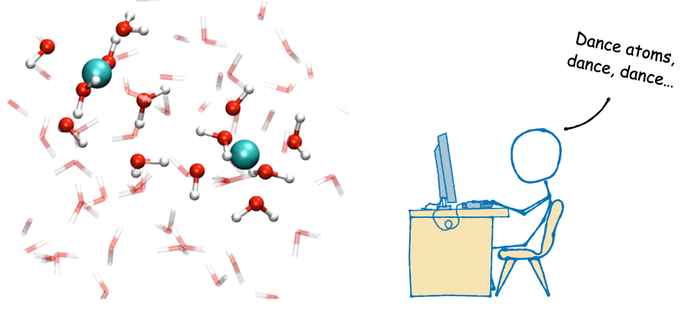
However, such ‘computerised experiments’ require a lot of time and computer power because quantum chemical calculations are complex, and on a molecular level, chemical reactions are quite rare events. Ensing explained how machine learning techniques can help here: Neural networks can be trained on accurate quantum chemical calculations to predict the interactions between the atoms and molecules. Ensing works with so-called graph convolution networks, invented by Max Welling and his group at the UvA in 2016. “It is a hundred to a thousand times faster and has pretty much the same accuracy as the quantum chemical data it was trained on. We are able to very accurately predict molecular properties, such as solubility, colour, toxicity, or interaction forces.”
The third and final example of how AI can boost chemical research is the ‘chemical ChatGPT’ mentioned earlier. To Ensing, this generative AI is the most groundbreaking and disruptive development in the history of molecular and material science. Much like large language models such as ChatGPT can generate text, this AI can generate molecular structures. It is based on the ‘chemical language’ hidden in the chemical representation of molecules (think H2O, CO2, and far more complex descriptions such as C8H10N4O2 for caffeine). These can be written out using standard ASCII characters using the Simplified Molecular Input Line Entry System (SMILES).
Generative AI is the most groundbreaking and disruptive development in the history of molecular and material science.
In the past years, machine learning algorithms such as chemBerta and molGPT have been trained on datasets with millions of SMILES strings of existing molecules to learn the chemical grammar. Basically, what they learn is the probability of the next character based on the available part of a SMILES string. “This is not completely random”, Ensing explained. “For example, a nitrogen atom is rarely followed by another nitrogen or an oxygen, and much more likely followed by a carbon. When the algorithm has learned this chemical grammar, it can generate new SMILES strings that resemble the molecules in the training data.”
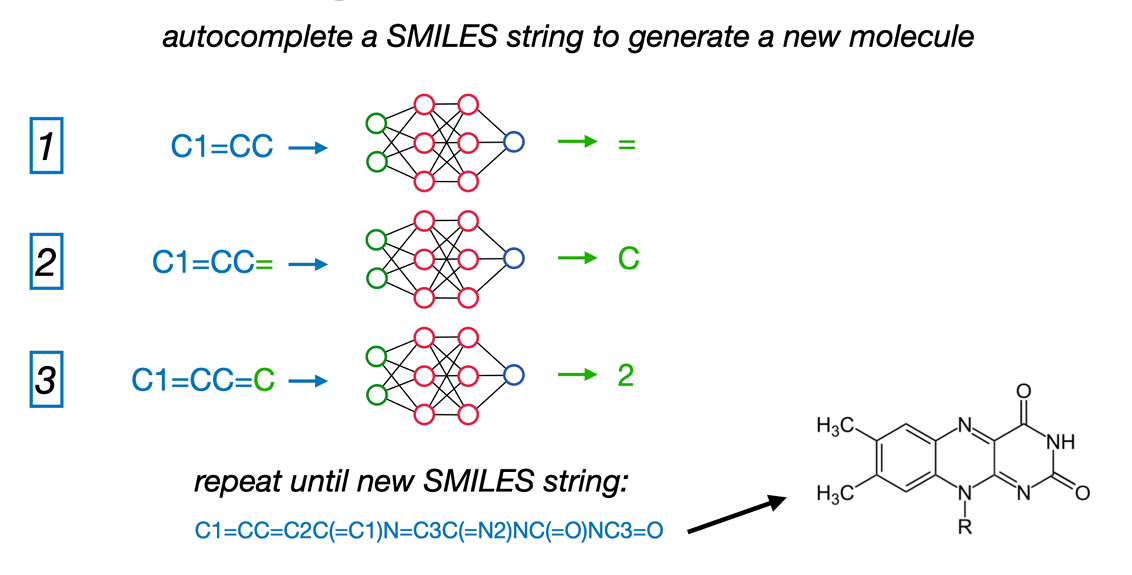
In fact, this is quite similar to the autocomplete function of text editors, suggesting the whole word after just a few characters. “Generative AI for chemistry starts with a few atom characters, and it will suggest the next one, and the next, and the next. Until it has completed a new molecule.”
Another approach for generating molecular structures is much like the way popular AI tools such as Dall-E can generate images. Again, after extensive neural network training on a dataset of hundreds of thousands of molecular structures, this ‘denoising diffusion’ approach can also generate novel molecular structures with chemically correct compositions.
Libraries of molecules
Of course, it is one thing to create whole libraries of possible new molecules using AI. Another thing is that these molecules need to be synthesised in the lab and tested for the desired properties. “We may not even have synthesis routes for many of them”, Ensing acknowledged. But with the growing body of knowledge, artificial intelligence will also speed this up. “Soon, we will have models that we can ask to generate only molecules with specific properties. For example, that it binds well to a certain protein for a medical application, or that it can absorb sunlight for an application in a solar panel or a sunscreen. The models that we are now developing will change completely how we do scientific research. I have no doubt that AI in chemistry will help a lot to create a circular economy and a sustainable and healthy planet.”