Bayesian Umbrella Quadrature streamlines free-energy calculations
Facilitating molecular dynamics simulations of a broad range of molecular systems and processes
6 July 2026
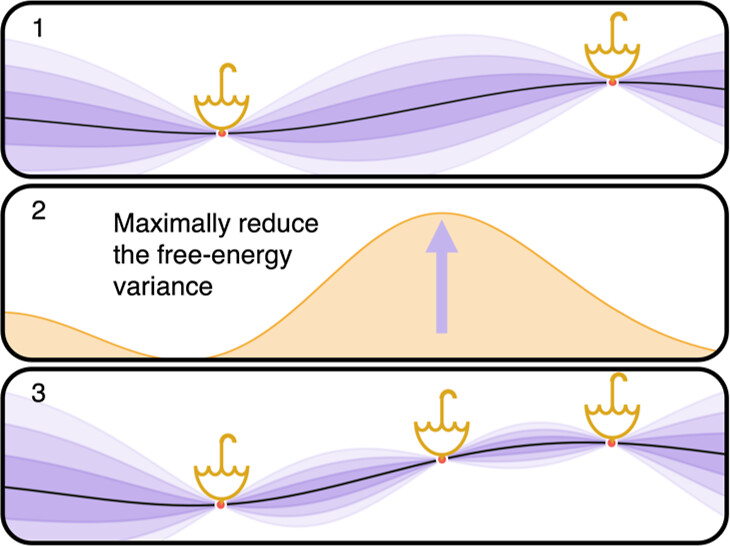
In molecular dynamics, biased sampling methods such as Umbrella Sampling help overcome time-scale limitations and obtain free-energy landscapes for complex atomistic processes. In practice, however, this requires a great deal of manual fine-tuning. In their paper, Kempkes and Pérez de Alba Ortíz now introduce Bayesian Umbrella Quadrature (BUQ) as an automated framework to significantly ease this often tedious process.
Built on Umbrella Integration, BUQ uses a Gaussian process model to iteratively choose bias locations and directly reduce the uncertainty of the free-energy estimate. It tackles free-energy landscape calculation as an inference problem, adaptively picking the most informative samples and accurately interpolating between them. BUQ has been validated across three fundamentally different processes: a peptide conformational change, a water-to-ice phase transition, and a substitution chemical reaction. In all cases, it significantly sped up the calculation when compared to standard methods.
The researchers facilitate upgrading to BUQ by providing interfaces to common simulation packages and presenting hyperparametrisation guidelines.
Abstract, as published with the paper
Biased sampling in molecular dynamics simulations overcomes time scale limitations and delivers free-energy landscapes, essential to understand complex atomistic phenomena. However, when applied across diverse systems and processes, biasing protocols often require time- and resource-consuming fine-tuning. In search of robustness, we automate a prominent biasing method, Umbrella Sampling, by leveraging the Umbrella Integration formalism for free-energy calculation. To estimate the value of an integral, i.e., the free energy, our Bayesian Umbrella Quadrature (BUQ) method iteratively selects gradient samples, i.e., bias locations, that most reduce the posterior integral variance based on a noise-tolerant Gaussian process model, which also effectively interpolates between samples. We validate the method for a conformational change in a small peptide, a water-to-ice phase transition, and a substitution chemical reaction; demonstrating that BUQ provides an automated free-energy calculation framework that is accurate and robust across fundamentally different systems and processes. To ease adoption, we interface BUQ with widespread simulation packages and share hyperparametrization guidelines.
Paper details
Eline K. Kempkes and Alberto Pérez de Alba Ortíz: Bayesian Umbrella Quadrature Automates Free-Energy Calculations Across Diverse Molecular Systems and Processes. Journal of Chemical Theory and Computation, Article ASAP, DOI: 10.1021/acs.jctc.6c00120. Code and data for Bayesian Umbrella Quadrature (BUQ) are available on GitHub.
See also
Alberto Pérez de Alba Ortíz: Simulation & design of molecular & soft matter systems