Why flow? Because the chemistry demands it!
How kinetic analysis guides photochemical process intensification
27 August 2026
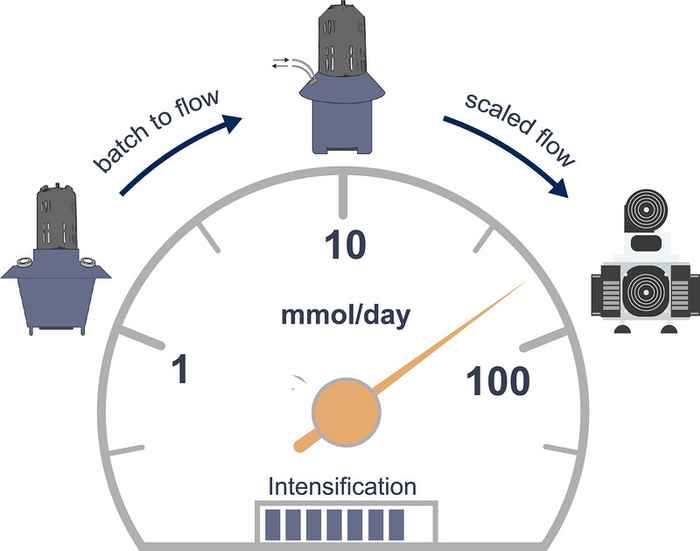
Beyond improving productivity and energy efficiency, the research by PhD students Jasper Schuurmans and Prakash Tiwari illustrates how integrating kinetic diagnostics into methodology development provides a practical framework for designing scalable photochemical processes.
The focus of the research was on photochemical Minisci alkylation of phenanthridine with ethane. Initially, developing this process with yield as the main objective led to ethane pressures of over 50 bar both in a batch and a flow reactor. Then, systematic screening of pressure, mixing, light intensity, and temperature revealed the controlling transport and kinetic phenomena, enabling targeted engineering interventions and reactor selection.
The resulting workflow guided the transition from batch to continuous flow and ultimately gram-scale synthesis, achieving a production rate of 19 g day−1 while operating under substantially less demanding conditions than the original methodology. By improving gas–liquid mass transfer and photon utilisation in continuous flow, the process could be operated at around 7 bar while achieving substantially higher productivity.
Paper detais
J. H. A. Schuurmans, P. C. Tiwari, and T. Noël: Guiding Photochemical Process Intensification Through Kinetic Diagnostics. Angewandte Chemie International Edition (2026), e2620716. DOI: 10.1002/anie.2620716