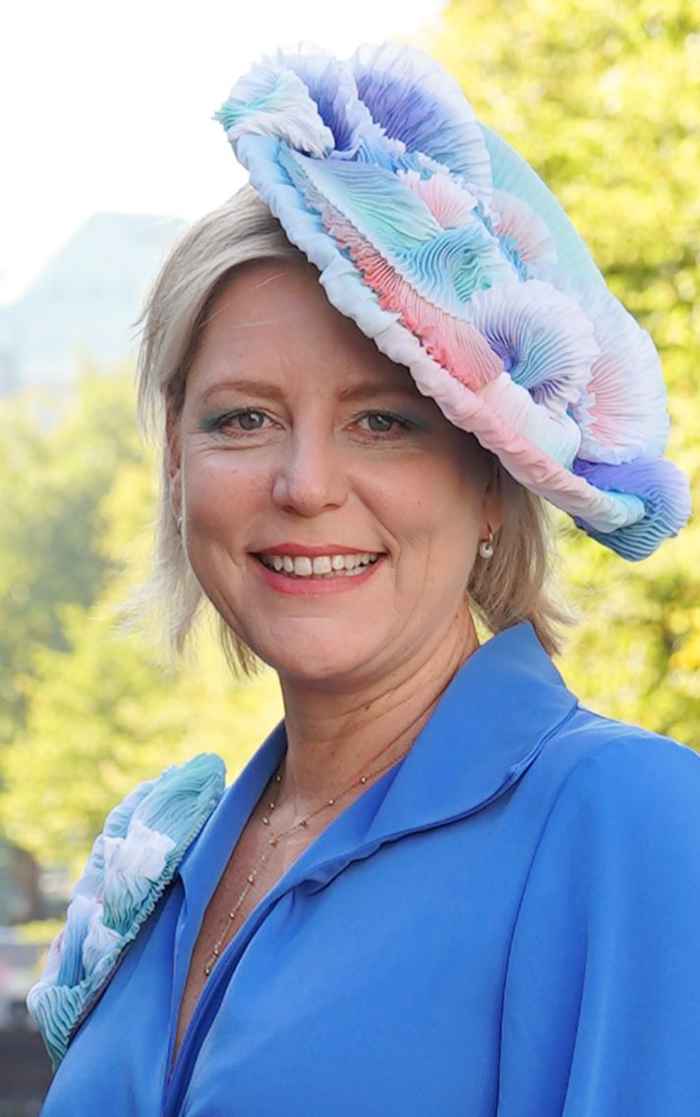
Minister Rianne Letschert wears hat inspired by research of Prof. Wim Noorduin
15 September 2026
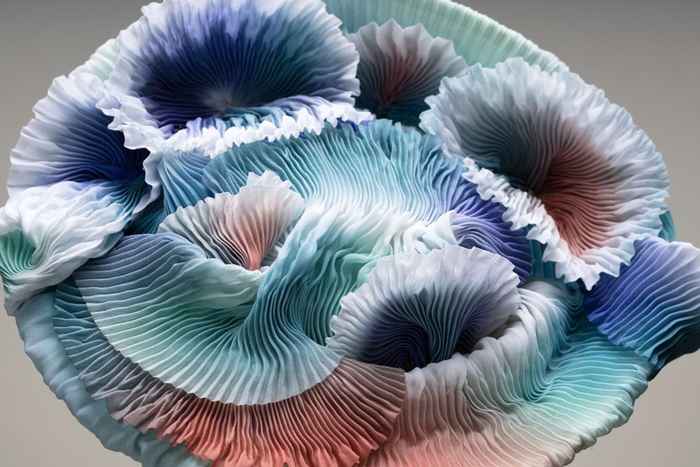
Noorduin is a professor by special appointment at the Van ’t Hoff Institute for Molecular Sciences at the University of Amsterdam and group leader at the AMOLF research institute. Driven by curiosity, he tries to find out how nature works using chemistry as his toolbox.
The hat worn by Letschert symbolises how this kind of curiosity can grow into innovations that make our society safer, healthier or more creative.
From a sense of wonder to a safer environment
The microscopic mineral structures studied by Noorduin look a lot like flowers. When he first discovered them, he was mesmerised by their beauty and felt as if he had stepped in a garden full of flowers. His fascination was shared by the editors of the renowned scientific journal Science, who featured one of his images on its cover.
A few years later, Noorduin discovered that his mineral structures could be transformed into so-called halide perovskites. These materials hold great promise as a new generation of solar cell materials. Thanks to Noorduin’s ingenuity, they now also form the basis for a spray that can make toxic lead visible.
Today, this lead detection spray is distributed worldwide by the company Lumetallix. It is used to detect harmful lead particles in people’s living environments. And it is also used by police in forensic investigations to determine where shots were fired and who fired them.
The power of collaboration between science and art
The Dutch Research Council (NWO) took the initiative to provide Minister Letschert with wearable accessories for Prinsjesdag, based on the scientific discoveries in Noorduin’s lab. Through its ‘Art Route’ of the Dutch Research Agenda, NWO brought Noorduin together with artist Malou Beemer and challenged them to create a hat symbolising the power of collaboration between science and art. In doing so, the hat also highlights the importance of collaboration across disciplines in creating an innovative society.
A shared fascination
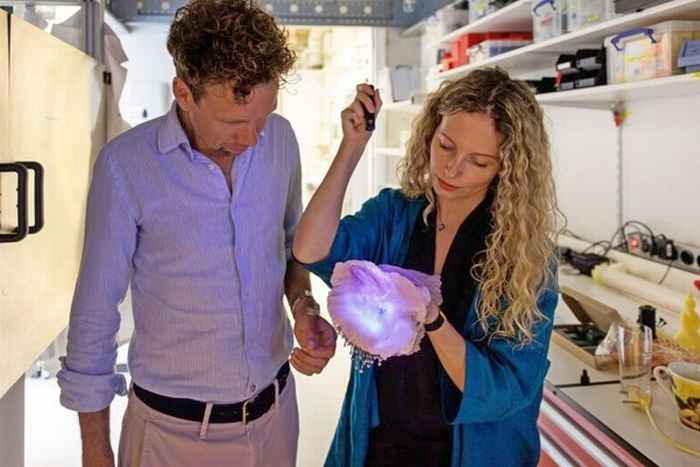
Beemer is a designer, artist, and researcher. In her work, she explores the relationship between people, the body, and their surroundings, using fashion, textiles, and technology to create innovative and socially sustainable designs. Through her studio, she works on interdisciplinary projects that focus on design innovation and interaction with textiles.
Noorduin found it very inspiring to work together with Beemer: “Malou and I are actually not that different from each other. Our starting point is the same: we are fascinated by processes in nature and how organisms use simple building blocks to create complex and functional structures. For example, we are both interested in processes that show emergent, or spontaneously arising, behaviour: as a result, the result is more than the sum of its parts.”
See also
- NWO launches the ‘Hat of Wonder’
- A lead test based on solar cell technology
- Solving crimes with glowing evidence: a brand-new method to detect gunshot residue at the crime scene
- Wim Noorduin wins prestigious NWO Stairway to Impact Award
- Wim Noorduin and Arian van Asten nominated for Huibregtsen Prize 2026