From Old Masters to contemporary floors
UvA and Forbo join forces to seek fundamental molecular insights
28 October 2026
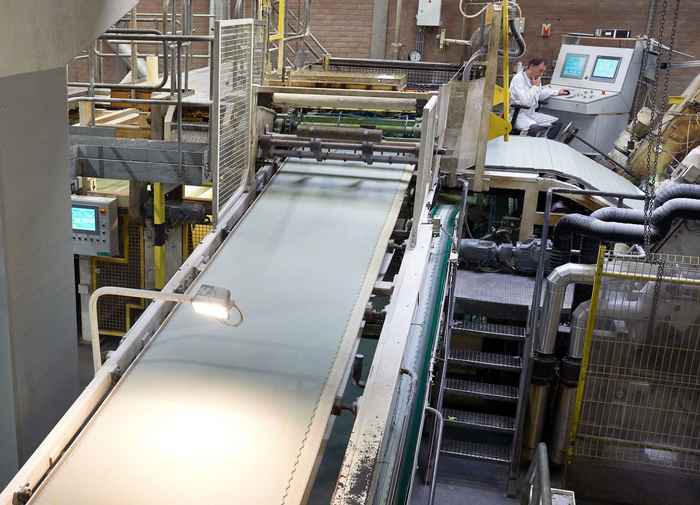
By drawing on Hermans’ expertise, Forbo hopes to gain a better understanding of the complex chemistry involved in linoleum production. To better understand how variations in raw materials and conditions affect linoleum properties, and improve its production processes. “Even though we have more than 125 years of experience with linoleum, we are constantly working towards further development,” says Roman Danser, Product and Process Developer at Forbo. “Joen’s expertise offers a unique opportunity to deepen our fundamental knowledge.”
Hermans, in turn, was immediately captivated by the subject. A visit to the factory in Assendelft reinforced his interest. He saw a surprising number of similarities between Forbo’s linoleum production and the aging processes in old paintings. “It’s not exactly the same, but I really see potential for us to explore the chemistry of linseed oil together and help each other move forward. We have a great deal of shared interest.”
Complex chemistry
Hermans realized that, from a chemical perspective, the mix of natural raw materials renders the production of linoleum quite complex. “You have to control all kinds of parameters. Think of the process conditions under which the linoleum cures, but also factors such as humidity and the time between different processing steps. All of that has a major impact on the exact properties. And when raw materials are sourced elsewhere, or if they’ve been in the storage tank just a little longer, production has to be adjusted accordingly.”
Danser emphasizes that the day-in, day-out production of high-quality linoleum is largely dependent on the knowledge and expertise of Forbo’s employees. “They know better than anyone how raw materials and semi-finished products behave, and how the production process must be adapted accordingly. Joen’s research gives us the opportunity to link new scientific insights about drying linseed oil to our daily practice. This allows us to continue broadening and strengthening our knowledge base.”
“There’s a very interesting parallel with our research into aging oil paint,” says Hermans. “There, too, we see this unruliness of linseed oil-based materials. The stability of paintings is also strongly influenced by climatic conditions such as fluctuations in temperature and humidity. The chemistry is very similar; that’s where we really found common ground. The challenge is to precisely determine the influence of all these parameters.”

Models and experiments
Dr Naomi Farrer has recently been appointed as a postdoctoral researcher on the project. Working with a climate chamber and using a range of characterization techniques, she will systematically investigate how the surface properties of linoleum and oil paint depend on production parameters and the changing environment.
But it doesn’t stop there, says Hermans: “At the university, we ultimately want to be able to understand what’s happening. That’s our added value, and ultimately, that’s important to Forbo as well. So we will also use well-defined model systems—for both paint and linoleum—that help us understand the molecular phenomena. For example, we can add or remove specific reaction products from the drying process to see how that changes the surface properties. In our experience, this kind of systematic research really helps us advance our understanding of these complex materials.”
Hermans hopes that, within the project’s one-and-a-half-year timeframe, it will be possible to draw meaningful conclusions. He views this industry-oriented research as an interesting challenge: “We’re really going to do our best to be of value to Forbo.”
See also