How machine learning and digital twins accelerate photoreactor development
From days in the lab to minutes on the computer
23 October 2026
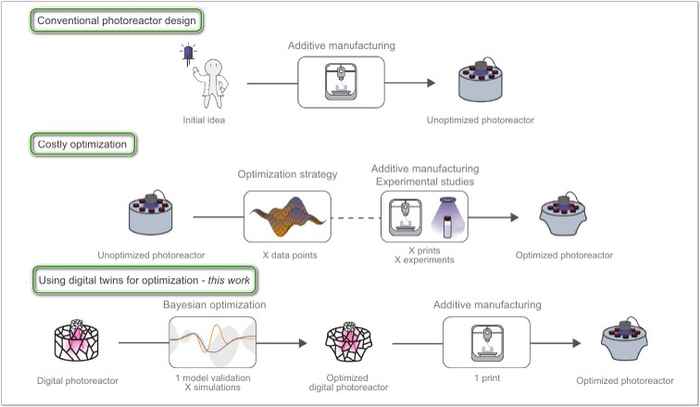
Even though 3D printing is widely recognised as a rapid prototyping technology, when used for photoreactor development it still requires a lot of time and resources. Printing a single photoreactor takes many hours, and its experimental evaluation might take several days. An iterative design workflow thus is quite time- and resource-intensive.
Now, researchers at the Flow Chemistry group of the University of Amsterdam’s Van ‘t Hoff Institute for Molecular Sciences have been able to significantly speed-up this process. They have developed an accurate digital twin of their photoreactor, allowing the simulation of photon travel through different reactor geometries. Coupling this model with multi-objective Bayesian optimization, they were able to simultaneously optimize photon capture and irradiation homogeneity across the 16 reaction vials in their system.
From days to minutes
This in silico approach allowed the team to computationally evaluate a reactor design in just five minutes on a standard laptop computer. It enabled them to rapidly explore different geometries, including rather counterintuitive ones, after which they 3D-printed the most promising ones. They then validated the predictions experimentally and used the optimized reactor for quantum yield screening, enabling mechanistic insights across diverse conditions in a single experiment.
This work thus establishes an experimentally validated virtual co-design framework in which machine learning and digital twins accelerate photoreactor development and support quantitative understanding of photochemical processes.
Paper details
Jasper H. A. Schuurmans, Miguel Claros, Elia Savino, Florian Lukas, Aidan Slattery & Timothy Noël: Closed-loop photoreactor design enabled by machine learning and digital twins. Nat Commun (2026). DOI: 10.1038/s41467-026-78785-2
See also