How preorganising a hairpin peptide will enhance its protein binding capabilities
6 October 2026
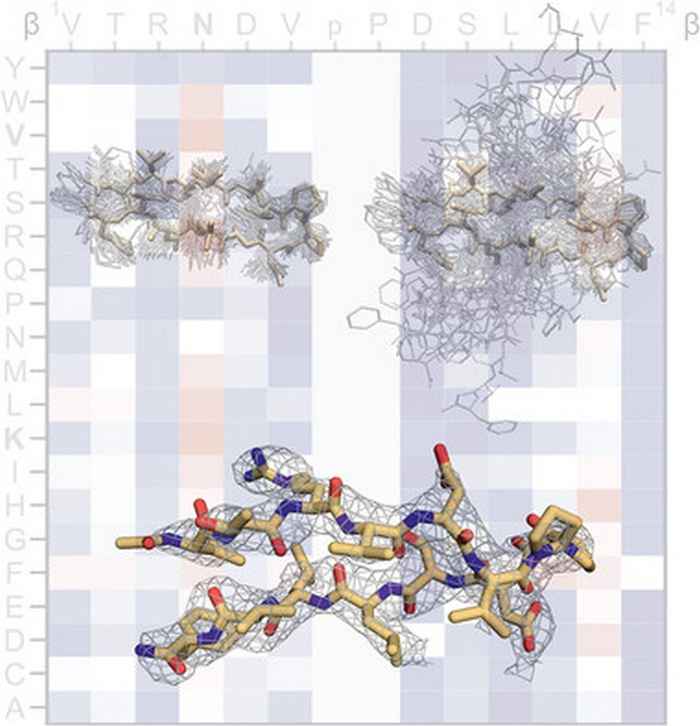
The paper provides an extensive mechanistic picture combining crystallographic evidence with biophysical and computational analysis of β-hairpin peptides targeting β-catenin, a key protein in cancer-associated Wnt signaling.
The results highlight that amino acid variations prestabilise the secondary structure of the peptide, allowing it to bind with higher affinity to the target. Notably, a single N4V substitution improves binding despite not directly contacting the target protein. Its effect combines additively with head-to-tail cyclization, further enhancing affinity.
The results of the mechanistic investigations stress the importance of intramolecular hydrogen‐bond networks for peptide‐protein binding, pointing to an alternative avenue for affinity optimisation.
The paper thus highlights the critical role of conformational preorganization in peptide‐protein recognition. It demonstrates that attention to solution‐state properties of the peptide can unlock substantial affinity gains. A focus on crystal structures alone provides only limited insight for optimising the peptide-protein interaction.
Abstract, as published with the paper
Peptide‐based inhibitors are promising tools to target challenging protein interfaces, yet improving their affinity and drug‐like properties is still a major hurdle. This holds particularly true for β‐sheet motifs with only limited strategies available to robustly stabilize their conformation. Previously, we reported linear β‐hairpin peptide l12 with micromolar affinity for β‐catenin, a central effector of aberrant Wnt signaling in cancer. Here, we show that a single N4V substitution markedly enhances binding, despite not directly contacting the protein surface as evidenced by obtained X‐ray structures and molecular dynamics simulations. Notably, the substitution combines additively with head‐to‐tail cyclization yielding a peptide with strongly increased affinity. This mechanistic study presents structural and computational analyses revealing that the affinity improvements arise from solution‐state preorganization and β‐hairpin stabilization mediated by an altered intramolecular hydrogen bond network. Our findings highlight the critical role of conformational preorganization in peptide‐protein recognition, demonstrating that optimizing solution‐state properties can unlock substantial affinity gains that are not obvious from crystal structures alone.
Paper details
Michael H. N. Meulendijks, Yun Li, Frederik J. Steiner, Rasmus Klintrot, Clemens Schulte, Seline Roose, Alejandro Yeste-Vázquez, Hans M. Maric, Sven Hennig, Felix M. Paulussen, Ioana M. Ilie, Tom N. Grossmann: Remote Residue Substitution and Macrocyclization Preorganize a β-Hairpin Peptide and Enhance β-Catenin Binding. Chemistry Europe, Volume 4, Issue 9 e70357 DOI: 10.1002/ceur.70357
See also