AI-guided autonomous lab for peptide optimisation
1 September 2026
An increasing number of medicines, such as Ozempic, are based on peptides. Improving the effectiveness of these peptides, for example, making them more water-soluble, is a crucial part of drug development. Researchers working on this often need to do lengthy, repetitive work that can even be dangerous when handling hazardous substances.

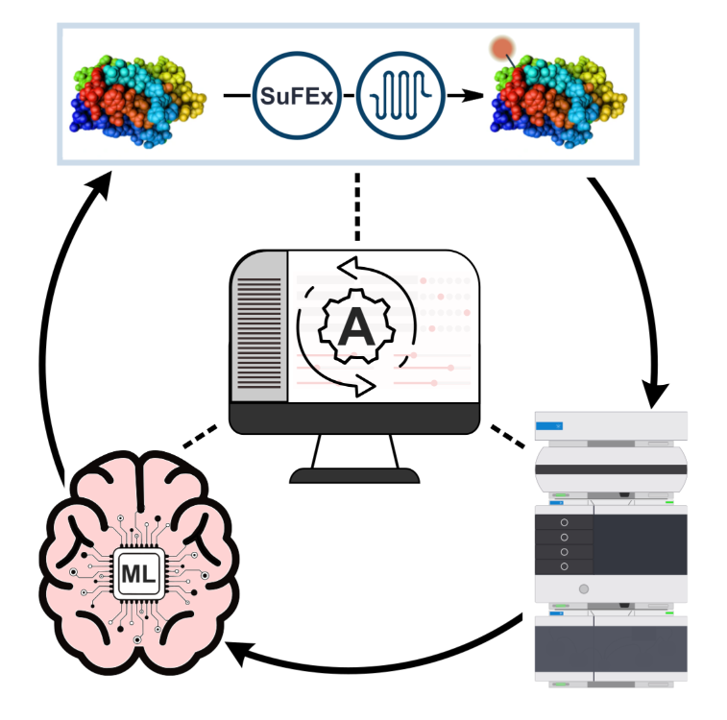
Automating this work would therefore be a huge step forward in both speed and safety. In previous work, UvA chemists from the Van 't Hoff Institute for Molecular Sciences led by professor Timothy Noël developed an autonomous synthesis robot that uses AI to accelerate molecule discovery. In a new MMD TechHub project, he teams up with assistant professor Andrea Gargano and associate professor Bob Pirok to integrate analytical instruments in the robot for peptide optimisation, creating the RoboBioConjugator.
Self-driving lab
Since 2020, Noël's flow chemistry research group has been developing robotic platforms, starting with RoboChem and later RoboChem flex, a new version with estimated costs of only 5000 dollars. Noël explains: 'In both cases, we want certain experiments to be carried out entirely independently by robots. That way, the chemistry becomes safer and can run 24/7. For example, if you want to verify a hypothesis at night, you can have the answer already in the morning.'
Technological developments such as RoboChem could have a major impact on future chemistry research. Noël views their technology as a tool in the toolbox that future chemists can use to their advantage. 'I'm really excited about how the technology can be used to accelerate and help solve fundamental research questions. Being the only ones in the world who have these robotic platforms, I think this is a great investment and a strategic advantage for the UvA as well.'

Optimising using AI
RoboChem can optimise the synthesis of about ten to twenty small molecules in a week, which would take a PhD student several months. It does that by optimising the reaction conditions to achieve the best yield. AI is a crucial part of the robot to efficiently and quickly find the most promising reaction conditions.
AI is specifically used to understand the correlations between different chemicals, Noël explains. 'In a chemical reaction, some chemicals may work together, while others counteract each other. When humans study this, they typically change one factor at a time to understand these correlations. An AI algorithm can establish those connections much more efficiently.'
Collaboration
Within the MMD TechHub project, the researchers aim to repurpose RoboChem so that it can be used to optimise peptides. This RoboBioConjugator will have integrated analytical instruments to enable peptide analysis. Because peptides are much larger molecules than the small chemicals that RoboChem currently works with, this requires a very different approach.
'That is why the collaboration with Andrea and Bob is so important,' says Noël. 'You really need to know how to analyse peptides before you can start conducting the research. MMD invested in the project to better streamline this collaboration.'