COAST grant to further develop the concept of polymer sequencing by enzymatic hydrolysis
24 March 2022
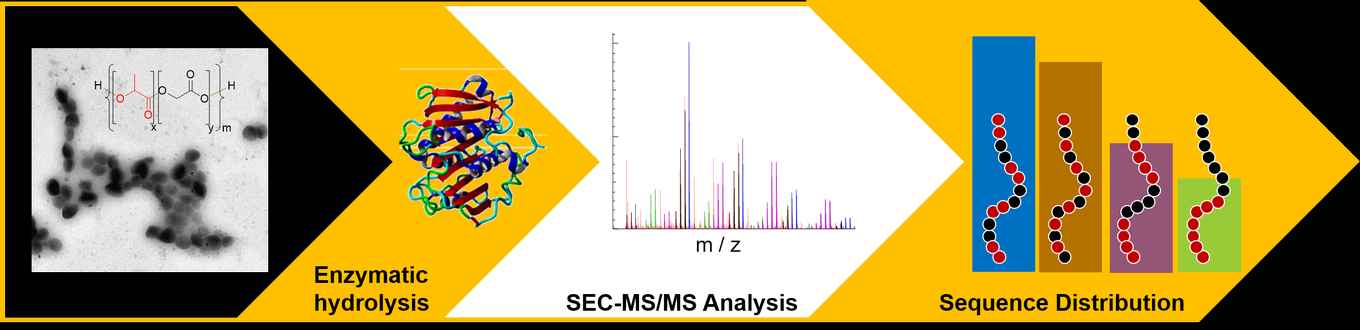
When developing biodegradable co-polymers for applications such as drug delivery systems, but also when designing new plastic materials that are more easily recyclable, it is crucial to relate their properties (e.g. tensile characteristics and degradability) to their composition and molecular structure. However, current state-of-the-art methods for polymer analysis provide only limited information about the chemical composition and molecular weight distribution of the polymers.
Enzymes to the rescue
In a novel approach, researchers Dr Andrea Gargano (Analytical Chemistry) and Prof. Francesco Mutti (Biocatalysis) at the Van 't Hoff Institute for Molecular Sciences (HIMS) have called enzymes to the rescue. Together with industrial partners (DSM, Covestro and InnoSyn), they have developed novel cutinase enzymes that selectively depolymerize polyester (co)polymers. Since the resulting oligomers are less complex and more soluble, they open a path for more detailed analysis of the original polymer strands. The researchers have dubbed their method POLY-SEQU-ENCHY which is an acronym for polymer sequencing by enzymatic hydrolysis.
In the Talent Fund (TAFU) XL project of COAST, the HIMS researchers will now team up with Corbion to elucidate the structure of the polyester-based poly lactic-co-glycolic acid copolymers by means of POLY-SEQU-ENCY. This will then be related to the use of these polymers for applications such as drug-delivery systems. The grant of 50,000 euros is intended to establish the 'proof-of principle' that will support subsequent public-private-partnership (PPP) grant applications.