Photochemical uncaging of large biomolecules in high vacuum
26 October 2023
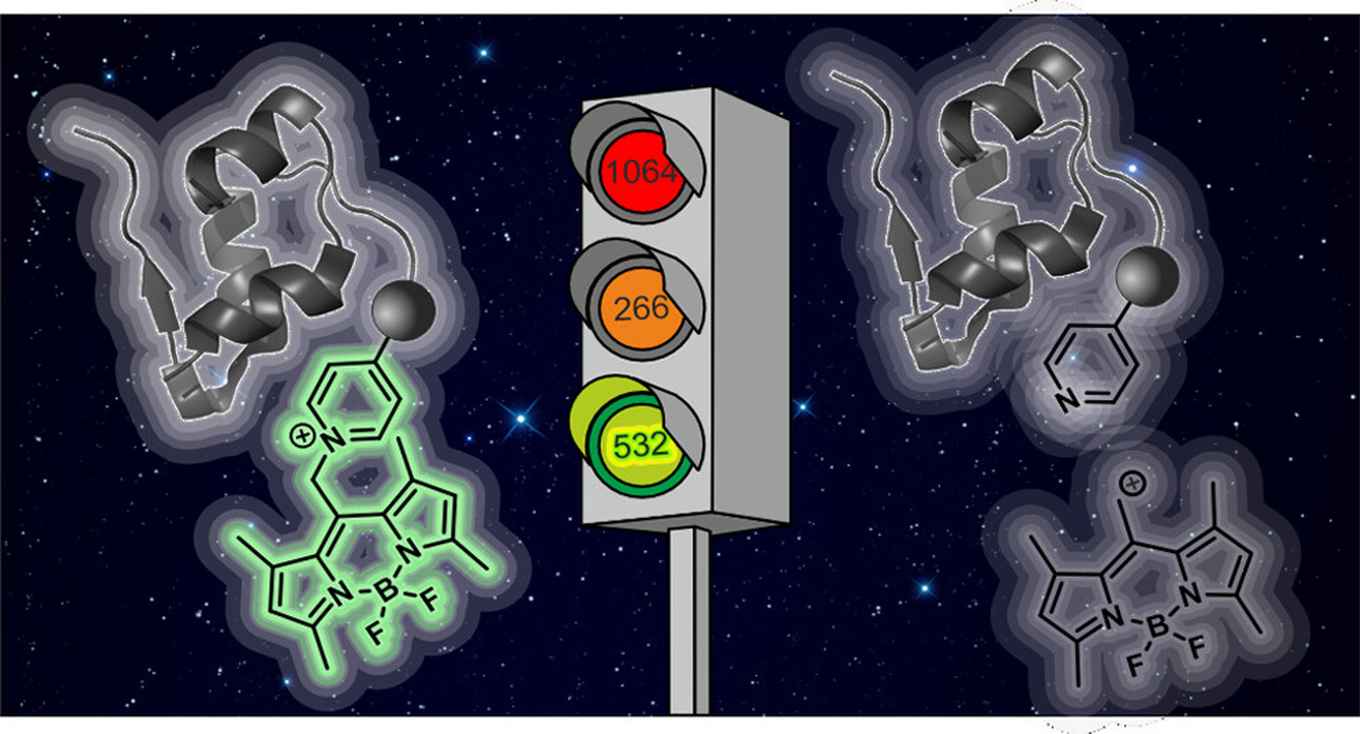
Mass spectrometry is an indispensable method to analyse large biomolecules such as peptides. For example, it allows to determine protein sequences and to probe structural integrity and dynamics of peptides including protein-protein and protein-ligand (e.g. DNA) interactions. Since these processes often depend on the charge state of the protein in the gas phase, the ability to manipulate this charge would open up new avenues of research. Think for instance of studying a protein folding event, or even testing the limits of quantum interferometry of heavy molecules, which requires neutral molecular beams in the gas phase.
Change of the protein charge can be achieved by using light and so-called photocages. A caged protein is a protein attached to a chromophore that permits liberating the protein upon light activation, like a bird released from a birdcage. If a laser is used to release a caged protein, a high spatial and temporal control of the process can be achieved. However, until now this has only been achieved in polar, often aqueous solutions. It is a daunting challenge to adapt the method for use in the vacuum conditions of mass spectrometry, where no solvent can assist such photoinduced charge control.
In their JACS Au paper, the researchers now sh\ow how a BODIPY photocage can be repurposed to optically reduce the charge of large peptides in vacuum up to the size of lysozyme and RNase A (m = 14 kDa), using a benign green light that cannot be absorbed by the protein itself. Their approach is general and allows investigating other biopolymers such as RNA or oligosaccharides and using other visible-light-absorbing photocages in high vacuum. The study thus opens a path to a plethora of new experiments that require a high degree of spatiotemporal control over molecular properties and dynamics in a high vacuum.
The research was carried out in a cooperation between the groups of Tomáš Šolomek at the University of Amsterdam, Valentin Köhler at the University of Basel and Markus Arndt at the University of Vienna. Researchers at MS Vision (Almere, the Netherlands) contributed to the work.
Abstract of the paper
The isolation of biomolecules in a high vacuum enables experiments on fragile species in the absence of a perturbing environment. Since many molecular properties are influenced by local electric fields, here we seek to gain control over the number of charges on a biopolymer by photochemical uncaging. We present the design, modeling, and synthesis of photoactive molecular tags, their labeling to peptides and proteins as well as their photochemical validation in solution and in the gas phase. The tailored tags can be selectively cleaved off at a well-defined time and without the need for any external charge-transferring agents. The energy of a single or two green photons can already trigger the process, and it is soft enough to ensure the integrity of the released biomolecular cargo. We exploit differences in the cleavage pathways in solution and in vacuum and observe a surprising robustness in upscaling the approach from a model system to genuine proteins. The interaction wavelength of 532 nm is compatible with various biomolecular entities, such as oligonucleotides or oligosaccharides.
Paper details
Yong Hua, Marcel Strauss, Sergey Fisher, Martin F. X. Mauser, Pierre Manchet, Martina Smacchia, Philipp Geyer, Armin Shayeghi, Michael Pfeffer, Tim Henri Eggenweiler, Steven Daly, Jan Commandeur, Marcel Mayor, Markus Arndt, Tomáš Šolomek, and Valentin Köhler: Giving the Green Light to Photochemical Uncaging of Large Biomolecules in High Vacuum. JACS Au 2023, 3, 10, 2790–2799 Publication Date: October 16, 2023. DOI: 10.1021/jacsau.3c00351
See also
- Website Šolomek Lab
- Website Köhler group
- Website ARNDT Group