Advanced equipment for self-driving analytical AI laboratory
Agilent Technologies provides 2D-LC-MS system to support method development in polymer analysis
9 December 2025
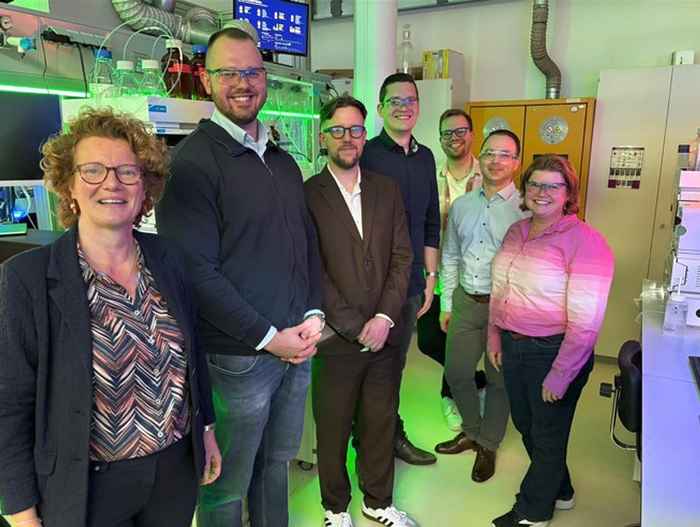
As modern polymers become increasingly complex in their molecular architecture and functionality, the demand for more powerful and comprehensive analytical approaches, such as two-dimensional liquid chromatography coupled to mass spectrometry (2D-LC-MS), has never been greater.
To advance the field of polymer analysis, the research group of Bob Pirok combines fundamental insights in separation science with automation and machine learning approaches to accelerate method development and improve polymer and materials analysis. In doing so, the group builds upon the strong foundation established by the former Polymer Analysis Group led by Prof. Peter Schoenmakers.
Pirok’s research is in many cases carried out in collaboration with industrial partners. An example is the STREAMLINED consortium led by Pirok and his HIMS colleague Dr Alina Astefanei, developing analytical tools to investigate nanoplastics. It includes researchers at the Vrije Universiteit Amsterdam and various polymer companies and instrument manufacturers.
Self-driving laboratory
In a new partnership, the Pirok group has now joined forces with scientific instrument company Agilent Technologies. The aim is to develop and evaluate advanced workflows that meet current and emerging challenges in polymer and materials characterisation
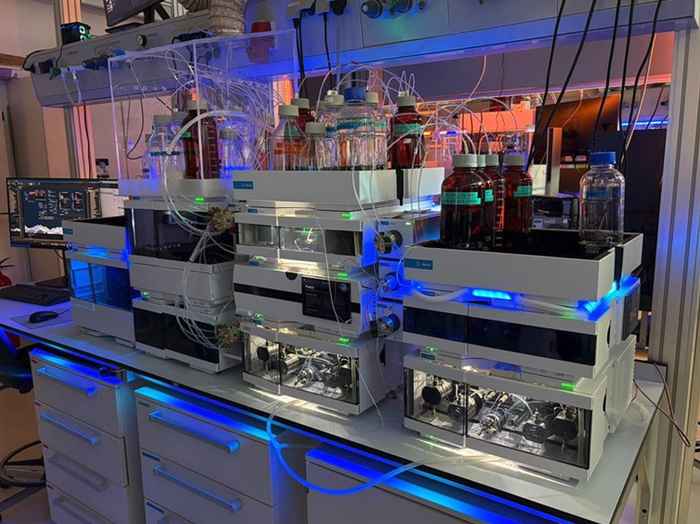
As part of the collaboration, an Agilent Revident LC/Q-TOF system has been installed in the HIMS self-driving analytical AI laboratory. “There, we design AI strategies that directly interact with analytical instrumentation to optimise 1D and 2D-LC-MS methods autonomously,” Pirok explains. “This project allows us to combine state-of-the-art instrumentation with cutting-edge AI so that we can explore new solutions to complex questions in polymer analysis.”
The new instrument is a welcome addition to the group’s AutoLC self-driving laboratory, an autonomous method-development platform for which Pirok received the HTC Innovation Award. It also fits in the research line of Dr Tijmen Bos, who designs data-analysis workflows specifically for polymers and has published solutions for several parties from industry. A recent example was the characterisation of the block-length distribution of copolymers using machine learning.