Left- or right-handed? Amsterdam research solves decades-old problem in analysis of molecular structure
Radically different approach improves analysis of experimental VCD spectra
17 December 2025
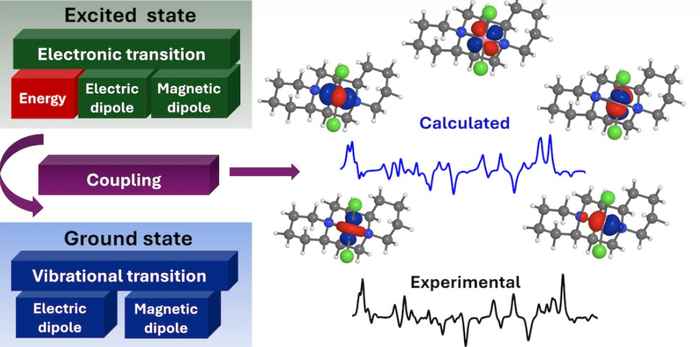
Many molecules can exist in two versions that are each other's mirror images. Given the analogy with human hands, which also occur in two different mirrored forms, these versions are referred to as left- and right-handed. Although their chemical composition is the same, they can have completely different properties. When used as a drug, one of the mirrored shapes can even be dangerous while the other helps cure a disease. It is therefore important to be able to quickly and unambiguously determine the exact ‘handedness’ of newly created molecules.
For this, Vibrational Circular Dichroism (VCD) spectroscopy offers a very powerful approach. It uses circularly polarized light that is absorbed differently by the two mirrored versions of the molecule. Comparison of experimentally recorded spectra with theoretically predicted spectra then allows to determine whether the molecule is left- or right-handed.
Solving the problem with metal atoms
Unfortunately, an important class of molecules has always escaped VCD analysis. Many biological relevant molecules and chiral catalysts contain a metal atom with electronically excited states at very low excitation energies, which inhibits for all practical purposes the theoretical prediction of their VCD spectra. In a collaboration between the groups of Prof. Luuk Visscher (Vrije Universiteit Amsterdam, theoretical chemistry) and Prof. Wybren Jan Buma (University of Amsterdam, experimental spectroscopy) this problem has now been resolved. A paper in Angewandte Chemie International Edition authored by PhD candidate Mariia Sapova (Vrije Universiteit Amsterdam) presents a radically different approach to theoretically predict VCD spectra of such metal-containing molecules - and thus unequivocally interpret their experimental spectra.
The novel approach consists of quantum chemical “Sum over States” modelling that includes explicitly all relevant electronic configurations. It thereby corrects for the assumptions on which the original VCD analysis is based, but which do not hold for such molecules. To make it work, however, the researchers had to overcome the intrinsic inaccuracies in calculated excitation energies. By considering these inaccuracies (within certain limits) as a fitting parameter, they were able to reproduce for the first time experimental VCD spectra with an accuracy that allowed for an unambiguous determination of the stereochemistry of such compounds.
More applications and improved methods
The improved VCD method now enables the study of metalloproteins that are key to vital biological pathways (cytochrome-c, myoglobin, carbonic anhydrase, etc.). This can increase our understanding of the structure and function of such biological molecules and pave the way for the prevention of disease and improvements in human health.
Furthermore, the new results can lead to an improvement in many current VCD analyses. It has long been known that adding a metal atom to a molecule can result in a stronger VCD signal, enhancing the sensitivity. Thanks to the new method this now indeed leads to meaningful analysis results, so that such enhanced VCD can become a reality. This for instance paves the way for easier and more reliable testing of the chiral purity of drugs.
Quantum computing
Finally, the researchers expect that future quantum computing can further improve their VCD method. The nature of quantum computing should in principle yield ‘exact’ excitation energies so that fitting of the inaccuracies will no longer be necessary. As in many other potential applications, it’s a matter of waiting for quantum computers with a sufficient number of qubits to perform the calculation. The researchers are already working on this, for instance identifying the requirements for such VCD quantum computing.
Paper details
Mariia Sapova, Dr. Chandan Kumar, Dr. Sahar Ashtari-Jafari, Prof. Dr. Wybren J. Buma, Prof. Dr. Lucas Visscher: Absolute Configuration Determination with Electronically Enhanced Vibrational Circular Dichroism Angewandte Chemie International Edition, Early View, e17979 DOI: 10.1002/anie.202517979
See also
- Left- or right-handed? Decades-old problem solved
- Vibrational Circular Dichroism spectroscopy for probing the expression of chirality in mechanically planar chiral rotaxanes
- University of Amsterdam improves method for determining the structure of complex molecules in medicines
- Left or right? Novel algorithm takes chirality determination to the next level