To stir or not to stir?
How mixing influences reproducibility and efficiency in synthetic organic chemistry
9 January 2026
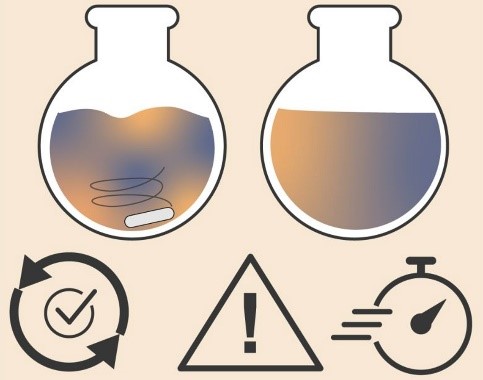
Although grounded in fundamental transport phenomena, the paper is deliberately written to remain accessible to a broad synthetic organic chemistry audience - keeping the math to a minimum and the focus on practical insight. It makes the point that recent reports, suggesting that stirring only minimally affects some solution-phase organic reactions, strongly oversimplify mixing’s complexity.
Even if some reactions seem agitation-insensitive, mixing remains crucial for reproducibility, scalability, and industrial applications. In small, homogeneous, slow systems, diffusion can sometimes suffice. But once reactions become faster, larger, multiphase, or exothermic, mixing directly controls reproducibility, selectivity, and safety. Ignoring this carries the risk of drawing the wrong mechanistic conclusions, or worse, creating hidden hazards.
The paper was written in close collaboration with researchers at the Sustainable Process Engineering Group at Eindhoven University of Technology and the Circular Chemical Engineering Group at Maastricht University.
Paper details
Jasper H. A. Schuurmans, Stefan D. A. Zondag, Arnab Chaudhuri, John van der Schaaf, and Timothy Noël: Stirring the Debate: How Mixing Influences Reproducibility and Efficiency in Synthetic Organic Chemistry. ACS Central Science Article ASAP, DOI: 10.1021/acscentsci.5c01825
Media attention
An earlier version of the paper published on ChemrXiv had already stirred up the debate, leading to media attention such as:
- Chemistry World: All stirred up: chemical engineers refute claims that ‘stirring doesn’t matter’
- Derek Lowe’s ‘In the Pipeline’ blog at Science: Reaction Stirring, Part Two
- C2W (Dutch): To stir or not to stir? Het belang van menging in de organische synthese
See also
- Research group Flow Chemistry