A community-driven standard for reporting MOF syntheses
Introducing the Material Preparation Information File (MPIF) to improve reproducibility
26 February 2026
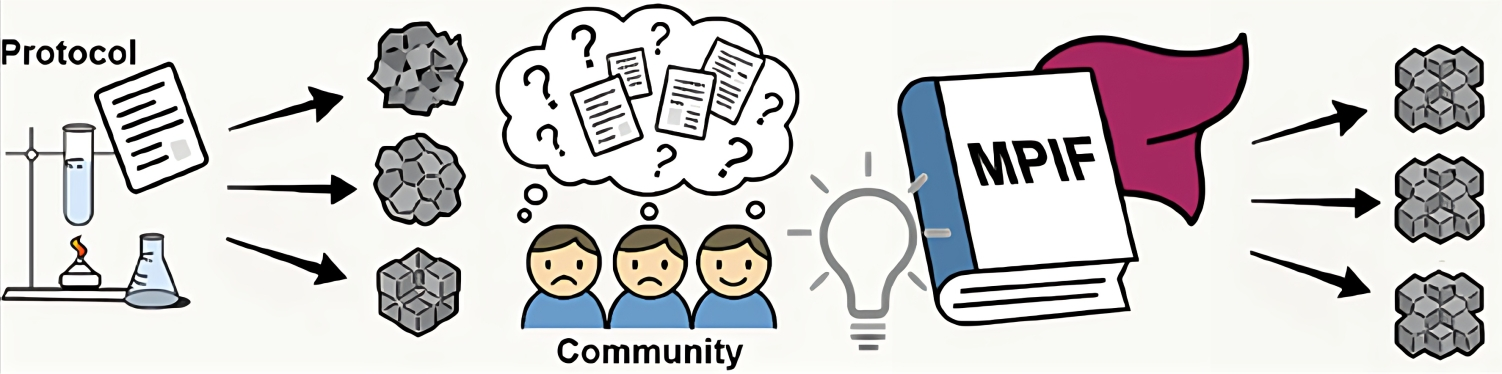
Featuring a modular, machine- and human-readable format, MPIF offers much-needed uniformity in documenting synthesis protocols and characterisation data. At the University of Amsterdam’s Van ’t Hoff Institute for Molecular Sciences, assistant professor Bettina Baumgartner co-authored the paper.
Researching chemical reactions in porous materials, Baumgartner has first-hand experience with the difficulties of synthesising such materials from the literature. “It is quite common that when you download the paper and follow the synthesis procedure, you do not get the product the paper describes. You often need to tweak or adapt to really make it work.”
Together with fellow researchers at the EU4MOFs research network, Baumgartner set out to tackle this problem of non-reproducibility. The team focused in particular on the description of the procedures for synthesis as well as characterisation. These vary considerably across papers, due to differences in research practices, in writing styles, and in the assessment of the important parameters. The latter is particularly relevant for MOF synthesis, which can be notoriously sensitive to detail.

Listing all essential aspects
In their paper in Advanced Materials, the EU4MOFs team presents a standard file format for listing all essential aspects of MOF synthesis, from chemical identities and reaction conditions to the type of vessels used. Named Material Preparation Information File, or MPIF, it contains all individual steps of the procedure, including workup and storage. Baumgartner: “The aim is to organise the reporting process so that researchers can be more thorough and consistent, and less likely to miss important details.”
In analogy to the file format developed for crystallographic data (the .cif file), MPIF is based on the STAR format for ‘self-defining text archive and retrieval’. Its set-up caters to the needs of chemists working in the lab, but at the same time, it is machine-readable, allowing for easy data processing. The team even developed a web-based user interface so that it can be used without any technical expertise in coding.
The EU4MOFs team hopes that all major scientific publishers will encourage—and ultimately require— the use of MPIF for the submission of manuscripts. They also urge the global research community to adopt MPIF as the standard for transparent and consistent reporting of MOF and related material syntheses.

A foundation for computational analysis
Baumgartner: “MPIF doesn't just help us write better procedures and make it more reproducible. It also facilitates benchmarking across data sets. Say we have five labs that make the same MOF using five slightly different routes. We can now compare those syntheses more easily and see what differences matter the most.” She also thinks MPIF will boost future re-use and analysis of synthesis data. “Because it's machine-readable and structured, we can plug it into all kinds of computational tools such as machine learning applications. It facilitates the training of AI models to predict whether a reaction will succeed or fail - or even propose new optimised synthesis conditions.”
MPIF adheres to the FAIR data principles (findable, accessible, interoperable, and reusable), which enable inclusion in larger databases and reuse of the data beyond the original project. “This is especially important when you think of big data efforts and material discovery. If we dare to think big, we can even think of expanding this into robotic labs or high-throughput labs. We could say that we have now laid the digital foundation for closed-loop experimentations or future self-driving labs.”
Paper details
Ocean Cheung, Shun Tokuda, Damian Jędrzejowski, Evelyn Ploetz, Bettina Baumgartner, Marzena Pander, Fengxu Yang, Jack D. Evans, Romy Ettlinger, Stefan Wuttke, Dariusz Matoga: Material Preparation Information File (MPIF): A Community-Driven Standard for Reporting MOF Syntheses. Advanced Materials, e21420, first published 15 February 2026 DOI: 10.1002/adma.202521420