Fast photon conversion in cinnamate derivatives
Tuning the structure of molecules to optimise their photoactive properties
16 March 2026
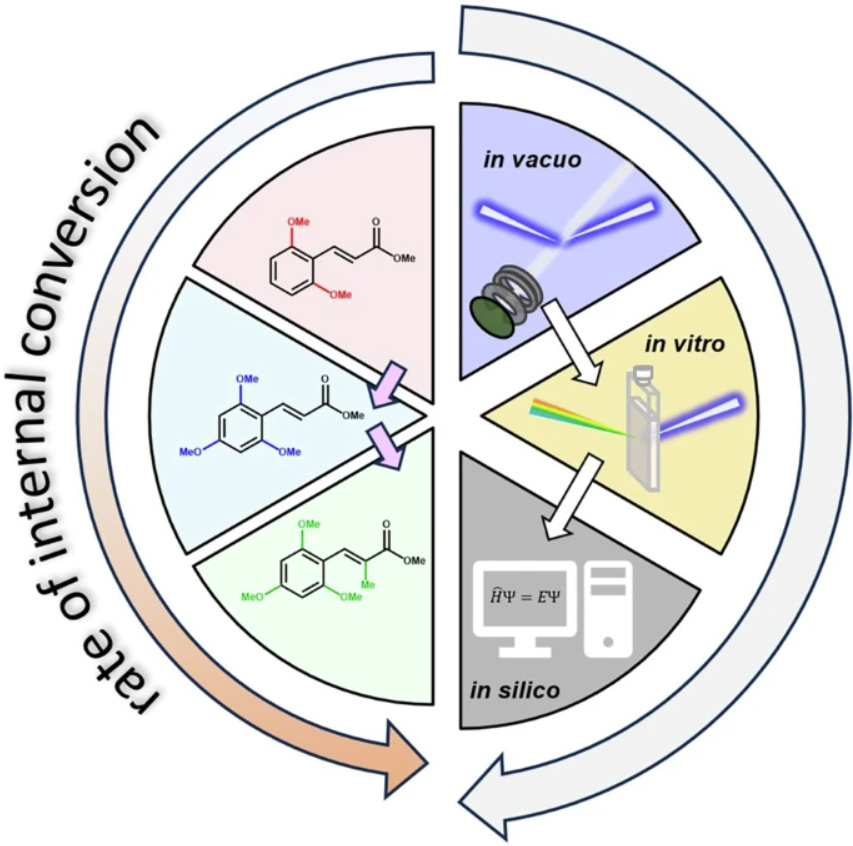
Simple derivatisations of photoisomeric structures can significantly increase their rate of photoisomerisation through perturbation of the potential energy surfaces of their ground and excited states. A particularly feature is reshaping the topography of so-called conical intersections (CoIns)where the potential energy surfaces of two electronic states become degenerate and have the same energy. Such an absence of an energy barrier results in extremely rapid conversion between the two states.
In the study now presented in Communications Chemistry, the researchers designed and synthesised derivatives of methyl cinnamate to tailor the internal conversion (IC) of electronically excited states to the electronic ground state along photoisomerisation pathways.
They first introduced electron-donating substituents on the phenyl ring to modulate the electron density around the isomerisable double bond, and then modulated steric interactions to facilitate access to the CoIn. Three methyl cinnamate derivatives were synthesised and studied using a range of spectroscopic techniques. The experimental results were corroborated with a range of quantum chemical calculations to identify key features of the molecular and electronic structure of the cinnamate derivatives, guiding the optimisation of the IC pathways.
The paper shows how targeted substitution on a simple isomerisable backbone can systematically tune internal conversion rates from the nano/picosecond to the femtosecond regime. This mechanistic insight provides a basis for designing systems for which efficient internal conversion is crucial, such as photon converters, UV filters, and photoswitches.
The study was carried out in the framework of the EU funded BoostCrop project and involved researchers at the universities of Birmingham, Warwick and Lyon. The long term vision of BoostCrop is to develop a highly efficient, environmentally friendly and affordable foliar spray containing biocompatible molecules that can harness solar UV energy and enhance crop growth. In 2025, the BoostCrop team was awarded a prestigious Faraday Horizon Prize by the Royal Society of Chemistry.
Paper details
Michael Hymas, Jack Dalton, Ivan Romanov, Hans Sanders, Mario Barbatti, Josene M. Toldo, Wybren Jan Buma & Vasilios G. Stavros: Optimizing photon conversion routes in cinnamate derivatives. Commun Chem (2026). Published 09 March 2026, https://doi.org/10.1038/s42004-026-01963-2
See also
- UvA researchers among ‘BoostCrop’ team to win Royal Society of Chemistry Horizon Prize
- 'Boostcrop' consortium receives millions to increase agricultural and horticultural yields