Not your typical textbook on Innovation Management in Sustainable Chemistry
2 March 2026
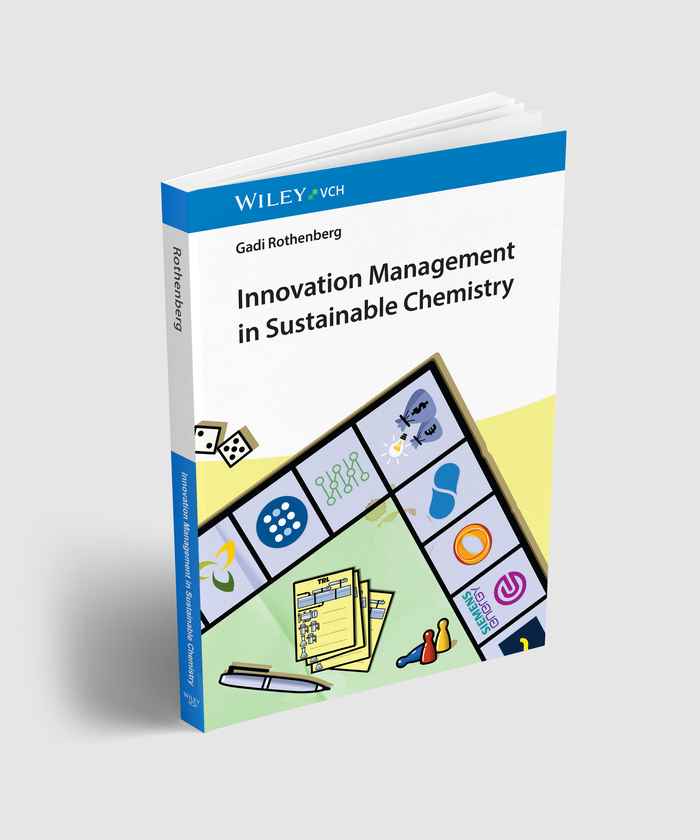
The stories anchor the presented knowledge in a web of anecdotes and experiences, resulting in an engaging text combining theory and practice. It is a book that teaches technical aspects, but also inspires students to go out of their comfort zone and follow their dreams.
Science and business principles
The book grew from Rothenberg’s course on sustainable chemistry start-ups, part of the Science, Business & Innovation bachelor program in Amsterdam. Written for science and engineering students with business ambitions, it shows how sustainable chemistry can move from the lab into the real world. The book takes a hands-on approach, offering exercises and teaching by example. “I wanted to write a book that reads like a story and answers the students’ questions”, says Rothenberg. “A book that encourages the reader to start their own chemical companies. Founding and building a company is challenging, and failure is common, but it is also a lot of fun.”
On the business side, Rothenberg covers project and product evaluation tools such as SWOT, PEST, and LCA. He then explains about business archetypes and narratives, business models, concepts of value creation, and value capture. The importance of team management, IP strategy and raising capital is also addressed.
Each section is presented as a question-and-answer dialogue with seasoned professionals, such as a patent attorney Lilian Hesselink who explains about IP, and venture capital fund manager Peter van Gelderen over the ins and outs of raising start-up capital.
Rothenberg sees the dialogues with these experts as an effective tool for transferring the knowledge to the students. “I can teach about catalysis or materials, because this is my expertise. I am not an expert on IP, business models or strategic investors. But I know people who are experts in these areas, who were willing to share their wisdom in these dialogues.”
Seven real-life case studies
The two foundation chapters are followed by seven real-life case studies. These recount the successes and failures of sustainable chemistry start-ups. The subjects include environmental monitoring, solar energy, biodiesel synthesis, CO2 conversion, hydrogen storage, and making polymers from biomass. Three of the stories are based on Rothenberg’s own companies Sorbisense, Yellow Diesel and Plantics. The others come from Siemens Energy, Evonik Industries, Avantium, Electriq Global, Hulteberg Chemistry & Engineering, and Independent Energy.
Each tale is told from people’s personal point of view, at times slightly adapted to avoid confidentiality issues. Several of the storytellers are connected to the UvA Faculty of Science. They include Dr Hubert de Jonge, who did his PhD at IBED, Prof. Alexandre Dimian, who used to work at the old Department of Chemical Engineering (ITS), and Prof. Gert-Jan Gruter, who works at HIMS and at Avantium. Their stories show that it’s often the human elements that determine the success or failure of sustainability ventures, more than the chemical ones.
Grey 'tech boxes' inspired by high-school textbooks
Rothenberg has adapted a device used in high-school textbooks, by placing technical explanations and mathematical derivations in grey ‘tech boxes’. “My son explained to me that in high school ‘everyone knows that you don’t have to read what’s in the boxes’, and I realised that this is also true for many of our students. The general principles and the stories are given in the main text. The tech boxes and exercises are there for those readers who want to delve deeper into the technology aspects.”