Cum Laude for chemist Sjoerd van Dongen
21 April 2026
Van Dongen carried out his research at the AMOLF research institute in the group of Prof. Wim Noorduin, who holds the chair of Self-Organising Matter at the UvA’s Van ’t Hoff Institute for Molecular Sciences. The Cum Laude distinction underpins Van Dongen’s capabilities as an independent and driven researcher, pursuing his research on the basis of his own observations and hypotheses rather than from predefined project plans.
In his PhD research, Van Dongen demonstrated his ability to explore genuinely unknown territory with an exceptional combination of conceptual clarity and experimental ingenuity. He was able to develop practical solutions to complex and poorly defined problems in the field of reactive crystallisation, and showed academic leadership while collaborating in an international consortium.
Essential components of pharmaceuticals
The thesis of Van Dongen addresses a fundamental and longstanding challenge in chemistry: discovering new routes to obtain chiral molecules. Such molecules are the building blocks of life and are essential components of pharmaceuticals and other bioactive compounds, yet they often remain difficult to produce efficiently.
Ever since Louis Pasteur first discovered molecular chirality and separated mirror-image molecules, crystallization has been one of the primary practical methods for obtaining chiral molecules. Despite more than a century of research, many fundamental questions remain about how chiral crystals grow and dissolve—particularly when coupled to chemical reactions that interconvert mirror-image molecules. Such systems are notoriously difficult to study experimentally since several competing processes occur simultaneously while influencing each other.
The thesis of Van Dongen forms a coherent conceptual framework for understanding reactive crystallization of chiral molecules. It integrates experimental observations, mechanistic insights, and practical strategies for controlling these processes. In a rare combination of conceptual innovation and experimental depth, it substantially advances the field of chiral crystallization and is likely to have a lasting impact on the field.
Summary of the thesis
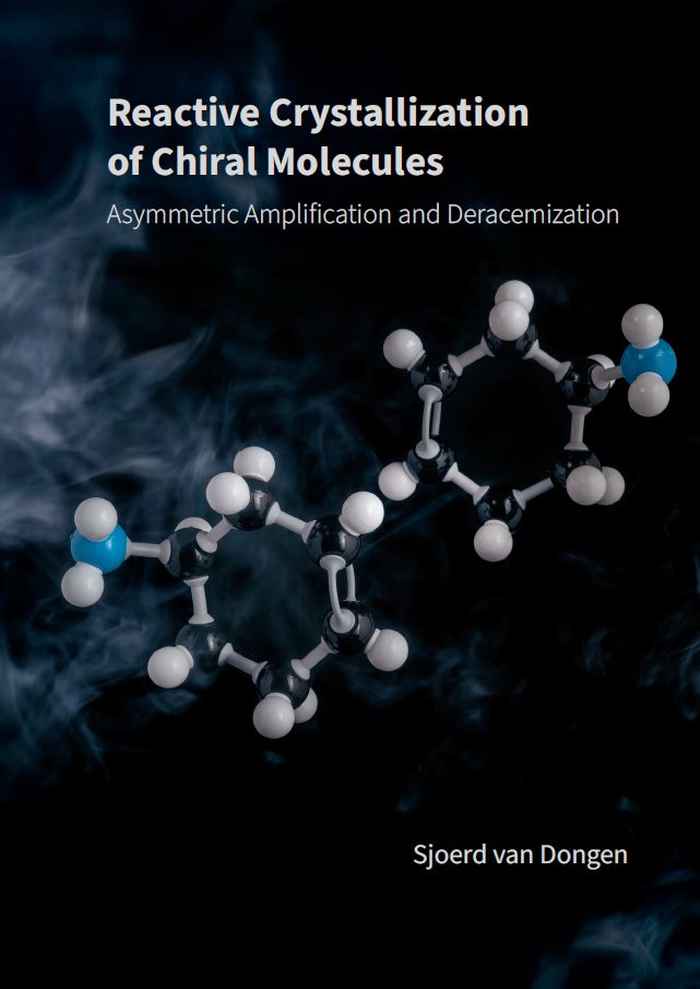
Chirality control and chiral amplification are central topics in chemistry, spanning origin-of-life scenarios and pharmaceutical manufacturing, where the undesired enantiomer may cause adverse effects. This thesis elucidates and exploits crystallization-induced deracemization, wherein minute initial chiral imbalances are amplified to full enantiopurity through combining a racemization reaction with continued cycles of crystal growth and dissolution.
We first demonstrate that crystal growth under racemizing conditions can itself already amplify enantiomeric excess. High ee-products can even be obtained from low-ee seed crystals. A mechanistic framework shows how the relative rates of racemization and crystallization determine whether seeds undergo erosion, consolidation, or strong amplification, with faster growth of the majority enantiomorphic crystal population as the driver.
We then reveal that crystal size and number distributions decisively steer asymmetric crystallization: cumulative growth-rate imbalances generate non-linear effects that can outweigh initial enantioenrichment and can be tuned—or inverted—by controlling the growth mechanism. By dissecting the contributions of crystal growth and dissolution, we next uncover a ratchet-effect: growth-driven enantioenrichment consistently exceeds dissolution-induced erosion. A fundamental dissymmetry between the ways crystals grow and dissolve is the reported origin. These insights guide more efficient deracemization strategies (e.g. disabling racemization during dissolution).
Capitalizing on lessons learned, an autonomous solvent-cycling approach is introduced to deracemize a blockbuster building block to full enantiopurity within near-record time. Finally, we argue that non-equilibrium crystallization and directed-evolution strategies can expand the scope of chiral crystallization beyond thermodynamically stable conglomerates, suggesting that kinetic conglomerates may be accessed for almost half the chiral molecules.
Sjoerd van Dongen: Reactive crystallization of chiral molecules - Asymmetric amplification and deracemization. Download the PDF from the UvA repository.