RoboChem Flex: democratisation of the autonomous synthesis robot
13 April 2026
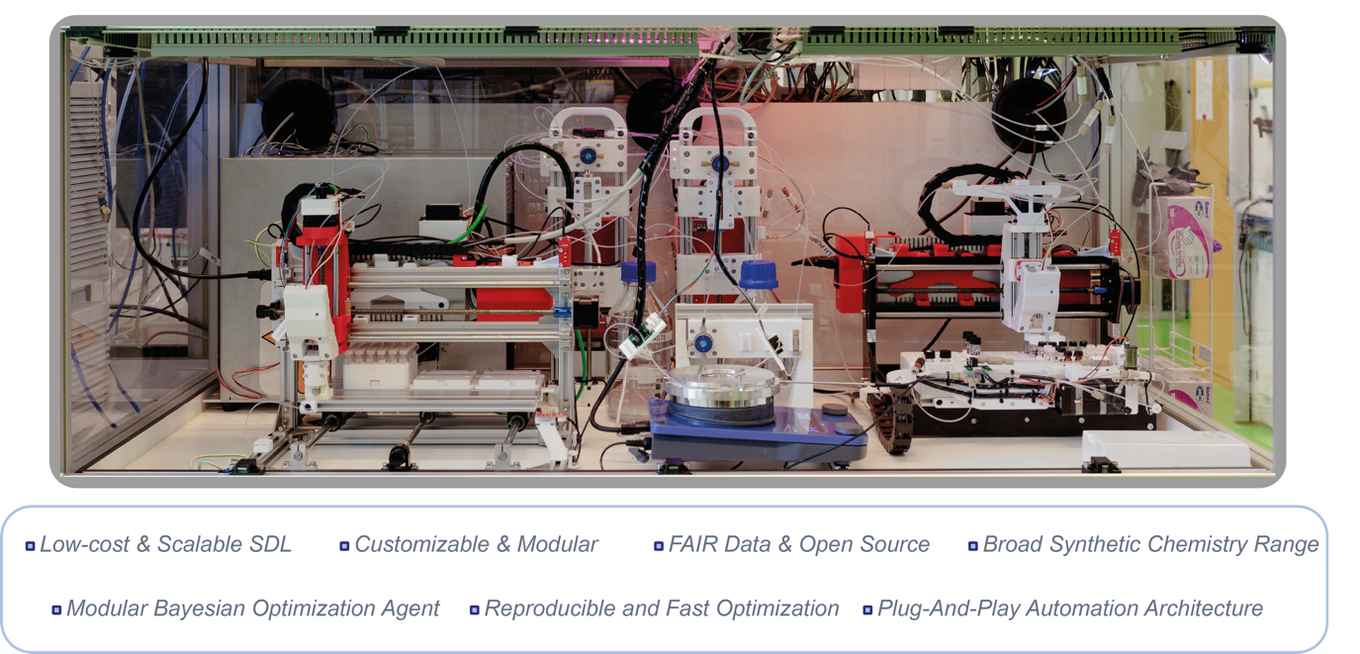
According to Prof. Noël, this new version of the RoboChem concept developed by his group will democratise the use of autonomous, sophisticated AI-powered synthesis systems. Such systems are often very expensive, so that only well-funded institutions can afford them. “We find such an exclusive privilege counterproductive to science. Scientific progress requires scalable, cost-effective tools that empower researchers across all resource levels. So we have now developed our system to be widely used, also by less well-established groups, boosting research capabilities, innovation opportunities, and scientific influence.”
Cost down, versatility up
Presented in the journal Science in early 2024, the first RoboChem system featured an autonomous system for flow chemistry, coupled to a benchtop NMR system for analysis, and controlled by an integrated machine learning AI-unit. In their original paper, the group demonstrated RoboChem’s power in accelerating chemical discovery of molecules relevant to pharmaceutical and other applications. Working autonomously round the clock, the system can optimise the synthesis of ten to twenty molecules all by itself, something that would take a PhD student several months.

“We were very proud to present RoboChem’s capabilities in Science”, Noel says. “On the downside, the system cost us over 50.000 dollar, not even including the very expensive NMR equipment. We decided to find a way to reduce cost while at the same time enhancing its versatility.”
The result, now presented in Nature Synthesis, is RoboChem Flex. The paper provides all the information for labs across the world to build their own system. Combining an estimated cost of around $5000 with capabilities in fields as diverse as photocatalysis, biocatalysis, thermal cross-coupling and more, Noel considers his mission accomplished. “There are other affordable automated systems out there, but these sacrifice research potential by focusing on narrowly defined problems. We have demonstrated RoboChem Flex in six challenging case studies covering diverse fields of chemistry. Each case study demonstrates how RoboChem Flex can be specifically tailored to the problem at hand. And of course, we have checked the real-world applicability of the RoboChem Flex results by performing the proposed syntheses in our lab.”
3D printed components and a ‘human-in-the-loop’ option
To ensure affordability and flexibility, RoboChem Flex uses readily available components or their 3D-printed counterparts. These not only significantly reduce costs but also allow for rapid customisation and iterative development. The communication between the hardware components is orchestrated by the dedicated OmniPlatypus package, developed in-house by Noël's research group and open source. It ensures seamless modularity and enables a plug-and-play architecture with minimal coding effort required from the user.
At the software level, RoboChem-Flex features an integrated, highly modular Bayesian Optimisation (BO) agent. This allows its users to customise the AI-driven optimisation of the synthesis workflow to meet specific experimental goals. The platform also supports integration with a range of inline analytical instruments, including NMR, UHPLC-MS, and Raman spectroscopy. Such integration enables a fully autonomous closed-loop operation, capable of autonomous reaction optimisation 24 hours a day.
However, adding the inline analytics would represent a considerable investment that could significantly exceed the 5.000 dollar of the system itself. Therefore, the Noël group decided to also develop a cost-effective, 3D-printed liquid sampling unit. “This module enables the collection of reaction samples”, Noël explains, “which can then be analysed using already available analytical equipment that is often shared among multiple research groups.” This human-in-the-loop approach provides a practical and affordable entry point for laboratories. Thus, by equipping resource-limited research groups with tools on par with those in well-funded institutions, RoboChem-Flex aims to level the playing field and foster innovation at all scales.
All code used for RoboChem Flex is openly available via GitHub. This includes, amongst others, machine learning and optimisation code, graphical user interface software, device firmware and operational control code, 3D printing design files and schematics for hardware.
Paper details
Simone Pilon, Elia Savino, Oliver M. Bayley, Michael Vanzella, Miguel Claros, Petros Siasiaridis, Junsong Liu, Florian Lukas, Matteo Damian, Vasilis Tseliou, Niccolò Intini, Aidan Slattery, Jesus SanJosé-Orduna, Tim den Hartog, Ron A. H. Peters, Andrea F. G. Gargano, Francesco G. Mutti & Timothy Noël: A flexible and affordable self-driving laboratory for automated reaction optimization. Nature Synthesis (2026). DOI: 10.1038/s44160-026-01053-0