NWO funding for collaboration with Ukraine
Light-driven chemistry squeezed into small pores
21 May 2026
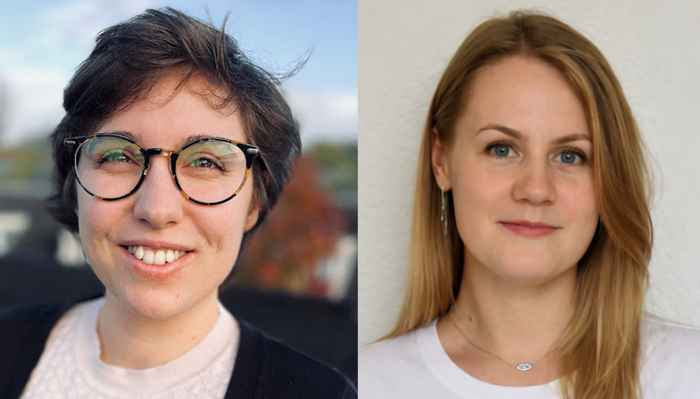
The collaboration brings together complementary expertise in dye chemistry (Kulyk) and advanced porous materials (Baumgartner). Together, the two researchers are seeking a better understanding of how the immediate chemical surroundings of a metal site influence reactions driven by light.
By sharing knowledge and jointly interpreting experimental results, they will study how small changes in molecular structure affect how light is absorbed and converted into chemical activity inside porous materials. Ultimately, the collaboration seeks to support the development of more efficient and sustainable light-driven chemical processes.
The collaboration is further strengthened by the fact that both researchers are part of the core team of COST Action EU4MOFs, a European network dedicated to advancing research, collaboration, and knowledge exchange in the field of metal-organic frameworks.
Light-driven chemistry using MOFs
The collaboration will add to a current research project in which Baumgartner investigates light-driven chemistry in metal-organic frameworks (MOFs), a class of porous materials that can host and organize light-active components in a well-defined environment. In her current research she uses commercially available porphyrins as light-active components. Initial results have shown that the distance between porphyrin units in MOFs strongly affects their photophysical behaviour.
To study this effect in a controlled way, porphyrins with different linker lengths are required. At the SSI “Institute for Single Crystals” of the National Academy of Sciences of Ukraine, Kulyk will focus on the synthesis and fine-tuning of such porphyrin-based molecules. She adds value to the project by providing expert input on the rational design and synthesis of porphyrins with controlled linker lengths and tailored coordination features, enabling a more targeted exploration of structure-property relationships. She will carry out molecular characterization using spectroscopic techniques to establish clear structure–property relationships before these building blocks are incorporated into MOF materials.
About the funding
The Hop-On Call for Researchers Based in Ukraine of the Dutch Research Council NWO offers ongoing projects the opportunity to add a qualified researcher from Ukraine to their project team. The initiative is intended to support Ukrainian researchers in expanding their professional network within the Dutch academic world. In the 2025 funding round, eleven ongoing Dutch NWO projects were awarded funding, totalling more than 270,000 euros.
See also
- Eleven new collaborations between Dutch and Ukrainian researchers
- Bettina Baumgartner, HomKat research group, HIMS
- Institute of Functional Materials Chemistry, laboratory of Organic Materials, Kharkiv, Ukraine
- COST Action EU4MOFs