A direct route to δ-lactones from simple alcohol feedstocks
Using carbon monoxide as basic C1 building block in photo-flow chemistry
11 June 2026
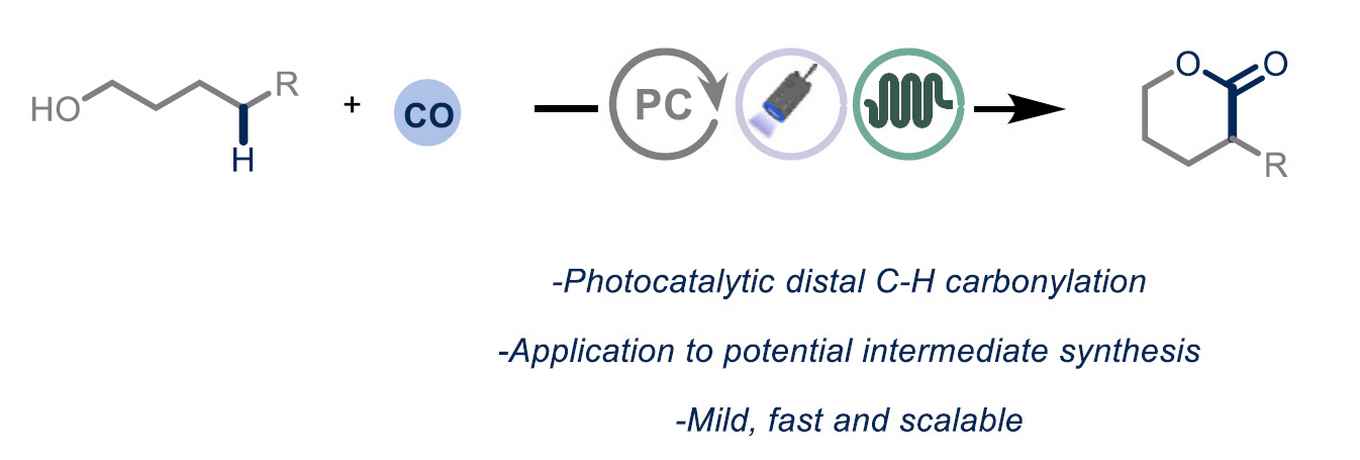
The study demonstrates how transformations that traditionally require long reaction times and toxic stoichiometric reagents can now be performed rapidly in continuous-flow reactors, with clear potential for scale-up. The presented strategy does not rely on complex, pre-functionalised substrates but instead starts from inexpensive and readily available feedstock materials, leading directly to valuable lactone architectures. More importantly, the study demonstrates how combining photochemistry, radical chemistry, and flow technology can unlock synthetic transformations using gaseous reagents, enabling the processing of CO in a safe, efficient, and scalable manner.
Abstract, as published with the paper
The direct carbonylation of unactivated C(sp3)─H bonds remains a fundamental challenge in synthesis. Herein, we report a photo-flow strategy for the δ-C(sp3)─H carbonylative lactonization of free alcohols using carbon monoxide. The transformation proceeds via photochemical generation of alkoxyl radicals, selective 1,5-hydrogen atom transfer, CO trapping to form δ-acyl radicals, and a crucial radical–polar crossover event that enables intramolecular cyclization to δ-lactones. The use of a strongly oxidizing acridinium photocatalyst is essential to promote acyl radical oxidation, distinguishing this manifold from conventional proton-coupled electron transfer (PCET) or ligand-to-metal charge transfer (LMCT) pathways. Continuous-flow conditions facilitate efficient gas–liquid mass transfer and safe handling of CO, enabling short reaction times and scalability. The method tolerates diverse functional groups and provides direct access to structurally complex and bioactive δ-lactone motifs from simple alcohol feedstocks.
Paper details
Prakash Chandra Tiwari, Runkang Liu, Timothy Noël: Direct δ-Lactone Synthesis From Free Alcohols via Photoinduced δ-C(sp3)–H Carbonylation in Flow. Angewandte Chemie International Edition, Early View, e5570038, first published 29 May 2026. DOI: 10.1002/anie.5570038
See also
Research group Flow Chemistry