Chemist Matteo Damian receives doctorate with Cum Laude distinction
2 June 2026
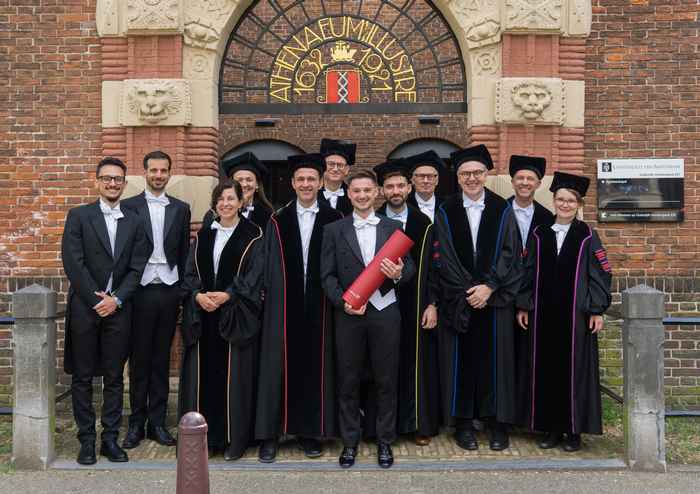
Matteo Damian’s thesis focuses on expanding the catalytic capabilities of alcohol dehydrogenase enzymes for sustainable chemical synthesis. It shows how enzyme promiscuity and protein engineering can be used to create new catalytic functions. Conceptually innovative, his research has led to the discovery and development of new-to-nature enzymatic reactivities. This already resulted in the sustainable synthesis of a range of highly relevant compounds for applications in pharmaceutical and fine chemical synthesis. It is also likely to stimulate further research on engineering new enzymatic transformations.
A collaborative attitude and remarkably high output
The quality of Matteo Damian’s work stands out because of his creativity, his scientific intuition, and his contribution to the development of innovative research directions. He also demonstrated strong critical reflection, placing his results in the broader context of enzyme engineering, organic synthesis, and green chemistry. He has shown to be a researcher with wide-ranging interests, a highly collaborative attitude and a remarkably high output. He contributed to fifteen scientific publications, either as first author or co-author.
The PhD thesis, reporting on his main original research at the Biocatalysis group, already reflects his initiative, independence, and scientific maturity. In addition, Matteo Damian collaborated with many researchers within and outside the group. He contributed to research in the area of bioelectrochemistry for chemical conversion and biosensing applications; he collaborated with the HIMS Analytical Chemistry group contributing his knowledge of recombinant enzyme production and electrophoresis analysis; and he worked with the HIMS Flow Chemistry group in assessing its RoboChem platform for the rapid optimization of biocatalytic reactions. Adding to all this, he supervised several Master’s and Bachelor’s students and even found the time to write chapters in two textbooks.
Abstract of the thesis
This thesis explores the versatile application of oxidoreductases, specifically alcohol dehydrogenases (ADHs), to expand the biocatalytic toolbox through novel methodologies and chemoenzymatic cascades. The research is divided into two primary trajectories: uncovering non-natural enzyme reactivity and integrating known biocatalysts into multi-step synthesis.
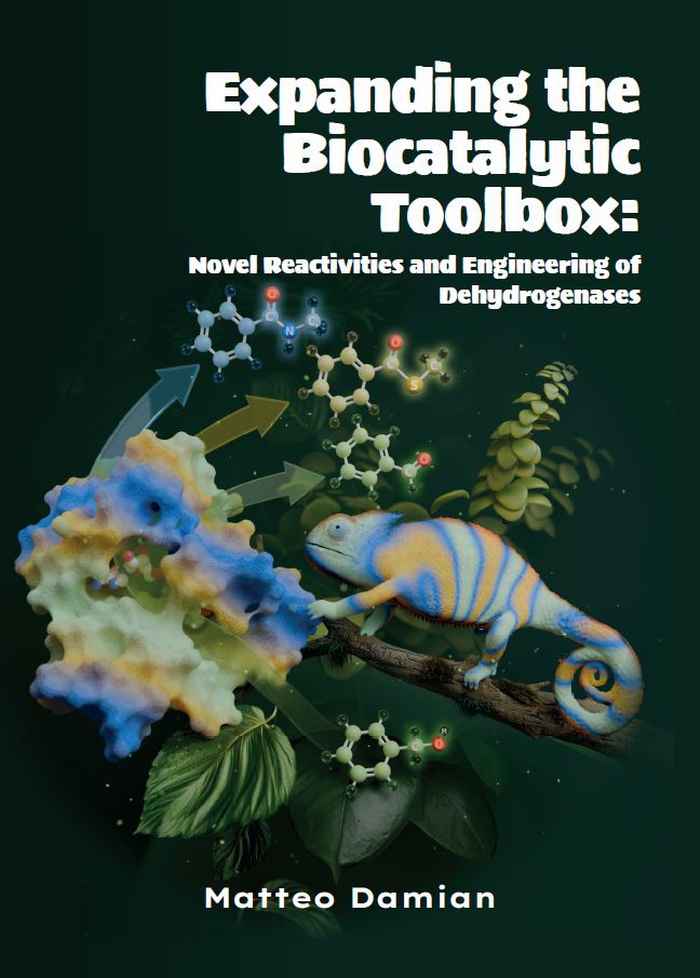
The first part investigates ADHs for unconventional transformations. Beyond the traditional reduction of ketones—highlighted by the characterization of two rare, anti-Prelog selective NAD-dependent ADHs, this work establishes ADHs as potent oxidative catalysts. By manipulating reaction environments and employing site-directed mutagenesis, new synthetic pathways were developed for the production of amides, thioesters, and esters from amines, thiols and alcohols. Furthermore, a sustainable, single-enzyme methodology for the oxidation of primary alcohols to carboxylic acids was developed, utilizing acetone as a sacrificial substrate for cofactor regeneration. The oxidative potential of ADHs was further demonstrated in a continuous flow system using immobilized enzymes on glass beads to achieve selective esterification.
The second part focuses on complex molecule synthesis via integrated catalysis. This includes an enantioselective chemoenzymatic cascade combining transaminases with organocatalysis, and the design of chimeric enzymes fused with formate dehydrogenase for streamlined cofactor regeneration in flow reactors. Finally, a nine-step retrosynthetic analysis of the antihypertensive API dilevalol is presented, combining eight enzymes with chemocatalytic steps.
Collectively, these findings demonstrate that the catalytic plasticity of ADHs, enhanced by protein engineering and flow chemistry, provides green and efficient alternatives to traditional synthetic organic chemistry.
Matteo Damian: Expanding the biocatalytic toolbox: Novel reactivities and engineering of dehydrogenases. Download the PDF from the UvA repository.