Machine learning for drug development leaky blood vessels
20 April 2026
Leaky blood vessels are a symptom of various diseases, from atherosclerosis and chronic rheumatoid arthritis to diabetes and Covid 19. This blood leakage results from high pressure within the endothelial cells, which are located inside the blood vessels. There is currently no medication available to combat this condition.
In a new research project by the UvA MMD TechHub, Bernd Ensing and Tati Fernández Ibáñez (Van 't Hoff Institute for Molecular Sciences) and Jaap van Buul (Swammerdam Institute for Life Sciences and Amsterdam UMC) are joining forces to develop medication against leaky blood vessels using machine learning.
Switching proteins on and off
The pressure within the endothelial cells in blood vessels is regulated by specific proteins known as Rho-GTPases. These proteins exist in two forms: activated (“on”), and deactivated (“off”). In the case of leaky blood vessels, this balance is disrupted. Therefore, researchers focus on creating a drug molecule that can switch these proteins from “off” to “on”.
The scientists of the MMD TechHub project use computer simulations of the protein for their research. Their aim is to find a candidate molecule that can induce changes in the protein's shape in the simulation. These candidates will then be tested in the lab of the Amsterdam UMC.
Machine learning techniques
To find this candidate molecule, the researchers use generative AI, among other techniques. Bernd Ensing, Professor AI for Chemistry, explains: ‘You can train the AI on a database of a million drug molecules, for example. Over time, it can recognize patterns in typical drug molecules. You can then generate millions of molecules.’
Starting with an initial molecule, the scientists use generative AI to create variants. But how do they know which variants are better than the original? For this, they will use a machine learning technique called Bayesian optimization. After determining which variants are better, the researchers make further variations of these molecules and step by step design an optimal candidate molecule.
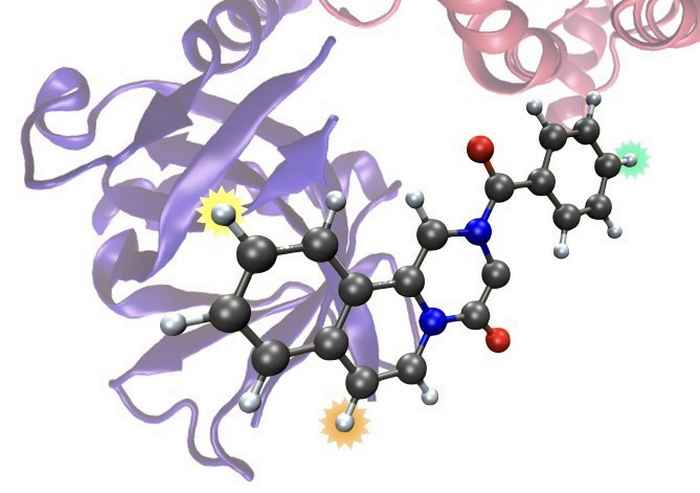
Ensing: ‘This is just an idea, it has never been done before. We are very curious to try this out. There may be other groups working on this in the world, but I have not seen any publications about it yet.’
Collaboration
An MMD TechHub project must be completed within a relatively short time frame, but this project has merged with a UvA Synergy project. Consequently, a PhD student can now work on it for four years. The scientists will also try to bring a functional drug to the market faster by starting with approved drugs as initial molecules. This allows them to bypass several stages of drug development.
For the development of specific drugs using machine learning, direct collaboration between different disciplines is crucial. Ensing is looking forward to this collaboration. ‘We now have a very nice team of people who are very passionate about areas completely different from my usual work. I will undoubtedly learn a lot from this, which is really great.’