A new way to deliver brain disease medicine using tiny nanocages
13 May 2026
According to the World Health Organization, around 50 million people worldwide currently live with neurodegenerative diseases, a number that is expected to increase as the global population ages. Neurodegenerative diseases, such as Parkinson’s disease and Alzheimer’s disease, are progressive conditions that damage and destroy parts of your nervous system over time, especially your brain.
Current neurodegenerative disease therapies can only reduce symptoms; they don't halt the progression of the disease. A mayor bottleneck is that the passage of molecules to the brain is restricted. Scientists are therefore exploring ways to transport drugs into the brain.
In a joint MMD TechHub research project, Ioana Ilie, Assistant professor Computational Chemistry, teamed up with Joost Reek, professor of Supramolecular Catalysis, and Carlos Fitzsimons, Associate professor Structural Brain Plasticity. Together, they came up with a new way to deliver drugs, specifically a type of RNA, using tiny nanocages.
Early intervention
Research on drug delivery primarily focuses on nanoparticles that encapsulate drugs. Once they reach the target location, these nanoparticles open and release the drug. Ilie explains: ‘Our nanocages work differently because they are smaller than conventional nanoparticles. We use complexes made of metal-organic cages with drugs attached to them.’
The main goal of the research project is to optimize the design of the nanocages, with a specific focus on using them to deliver a particular type of RNA. In the cell, the “silencing” RNA can interfere with the production of disease-related molecules. This could potentially prevent further disease progression. Ilie: ‘The hope is that in this way, we can intervene in the early stages of brain diseases and prevent its propagation.’
Cycles of improvement
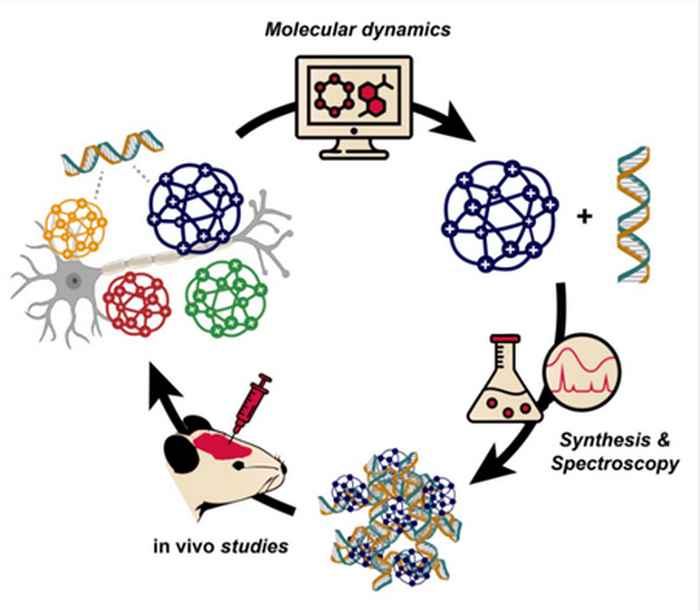
The optimization of nanocages for drug delivery brings together several research disciplines: synthetic chemistry, computational methods, and biological experiments. Researcher Indigo Bekaerkt, from Ioana Ilie’s and Joost Reek's research groups, works on both synthesizing the cages, optimizing them using computational methods and understanding their dynamics in the biological environment. Another researcher in Fitzsimons’ group, Oliver Polzer, focuses on the biological side and tests the nanocages in mice.
The researchers apply machine learning and simulations to understand the interactions within the biological environment and use this knowledge to improve the design of the nanocages. Ilie explains: ‘Machine learning could be used to improve both the computational and the synthesis aspects. However, to see if a design really works, it needs to be made and tested with biological experiments as well.’
The results from the biological experiments can then be used as feedback for the machine learning algorithm to improve the design. This way, the scientists will create cycles of improvement and steer the design of their nanocages in a desired way.
Close collaboration
Working in an interdisciplinary team allows the research team to learn a lot from each other, says Ilie. ‘It was a bit difficult at the beginning to get accustomed and use the same language, but I think we managed that quite quickly. The postdocs we hired for the project are doing a fantastic job, because they're in constant contact with each other and really make an effort to understand and link to each other's work.’
At the moment, the scientists are applying for additional funding to be able to prolong the research project. The pharmaceutical industry seems interested in it, because it uses an innovative new approach to drug delivery. Ilie: ‘We are applying for more application-oriented grants to attract pharma and biomedical companies. I believe this kind of innovative project could significantly strengthen the biotech industry in the Netherlands.’